Adders
This lecture provides an in-depth overview of various types of adders used in digital logic design, including basic ripple adders, faster adders, and sequential adders. It covers half and full adders, their gate delays, and the performance implications of using different adder architectures. The discussion extends to higher-order symbols for reducing circuit clutter and multiple-bit adders' complexities. Special focus is placed on the carry-lookahead adder methodology to improve addition speed and efficiency. Learners will understand the trade-offs between time and area in adder design.

Adders
E N D
Presentation Transcript
Adders ECE 561 Lecture 15
Adders • Basic Ripple Adders • Faster Adders • Sequential Adders ECE 561 Lecture 15
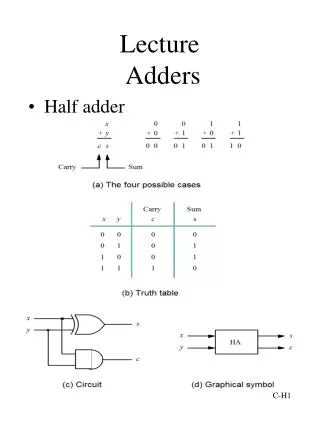
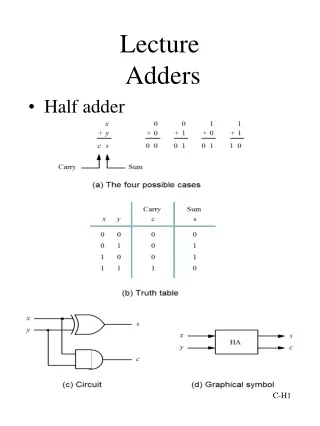
The Half Adder • Half Adder • Input is limited to 2 bits • HS = X xor Y • = X•Y’ + X’•Y • CO = X•Y • Time for the Half Adder? • 1 gate delay • A gate delay of an xor for the half sum • A gate delay of an AND gate for the carry out ECE 561 Lecture 15
The Full Adder • Input is now A B and the Carry in. • So have • S = X xor Y xor Cin • =X•Y’•Cin’+X’•Y•Cin’+X’•Y’•Cin+X•Y•Cin • Cout = X•Y + X•Cin + Y•Cin ECE 561 Lecture 15
The logic • Two level logic • Output delay • A, B Cin Sum • Delay through 2 xor gates • ts = 2 txor • A, B Cin Cout • Delay through an AND gate and an OR gate • tCout = tand + tor ECE 561 Lecture 15
Higher order symbol • When using full adders in a circuit it becomes too cluttered if all gates are shown • Use a symbol for the unit ECE 561 Lecture 15
Multiple Bit adders • There are multiple approaches • Most Basic is the Ripple adder • You can also do as good as a ripple adder • One figure of merit to evaluate is the area*time product • In a ripple adder the number of gates (area) grows linearly with the number of bits and the time also grow linearly. ECE 561 Lecture 15
The Ripple Adder • Basic structure • Delay for n bits • tADD = tXYCout + (n-2)tCinCout + tCinS ECE 561 Lecture 15
And in gate delays • tADD = tXYCout + (n-2)tCinCout + tCinS • Where • tXYCout = tand + tor + (n-2) (tand + tor) + txor • = (n-1) (tand + tor) + txor • As number of bits goes up time increases linearlly. Number of gates increases linearly. ECE 561 Lecture 15
Which is more important factor? • Usually time is the more important factor for an add. • Why? • It is on the critical part for the instruction cycle time in any computer. • Why has it become more important today? • Address space has increased, programs are larger more bits in program counter. ECE 561 Lecture 15
How to add faster • The most significant Sum bit of the adder is a function of all the inputs. • Could just do a straight logic equation for each Sum bit as a function of all the bits of which it is a function. • Or use a methodology • That methodology is called carry-lookahead ECE 561 Lecture 15
Carry-Lookahead Adders • Start by defining two functions • Generate gi = xi•yi • Propogate pi = xi + yi • And ci+1 = gi + pi•ci or (expanding out) • Having pi and gi, can now write the carry output of a stage • c1 = g0 + p0 c0 • c2 = g1 + p1 c1 = g1 + p1 (g0 + p0 c0 ) • = g1 + p1 g0 + p1 p0 c0 ECE 561 Lecture 15
CLA continued • c3 = g2 + p2 c2 • = g2 + p2 (g1 + p1 g0 + p1 p0 c0) • = g2 + p2 g1 + p2 p1 g0 + p2 p1 p0 c0 • c4 = g3 + p3 c3 • = g3 + p3 (g2 + p2 g1 + p2 p1 g0 + p2 p1 p0 c0) • = g3+p3g2 + p3p2 g1 + p3p2 p1 g0 + p3p2p1p0c0 • And this can continue for as many bits as you want. ECE 561 Lecture 15
The logic • Implementing into gates ECE 561 Lecture 15
Analysis • Had our time for 4 bit addition from a ripple adder. • Here the slowest bit is the msb output as it has the largest logic function. • Multiple input gates are slower than 2 input gates. • Start with the time for the propagate and generate signal logic • tpg = max(tand , tor ) ECE 561 Lecture 15
Analysis cont • Now must generate s4 output • ts4 = tpg+ tor4+ tand4+ txor • Assume that 4 input gate is ½ the speed of 2 input and gate • Assume xor time is 1.5 the speed of and • ~= 5.5 tand + tpg • If tand ~= tor time is ~= 6.5 tand versus a time of ~2 n tandfor a ripple adder where is the number of bits ECE 561 Lecture 15
In terms of gates • A full adder takes 6 2-input gates • An n-bit ripple adder will take 6n gates • The Carry Lookahead Adder • 1st stage 5 gates (max of 2 input) • 2nd state 7 gates (max of 2 input) • 3rd stage 8 gates (max of 3 input) • 4th stage 9 gates (max of 4 input) • As you use more stage the area grows exponentially if you limit the number of inputs to the gates ECE 561 Lecture 15
Tradeoff • The ripple adder versus the carry look-ahead adder is a classic time and area tradeoff. • In many circuits you can reduce time by using more logic to produce the output more directly. ECE 561 Lecture 15