Controls, Variables & Designing Experiments
Scientists observe the world and form testable hypotheses using the format "If..., then..., because...". In experiments, variables play a crucial role. The independent variable is what the scientist manipulates, while the dependent variable is what is measured, revealing the experiment's outcome. Constants, known as controls, are maintained to ensure fairness. A good experimental design includes a logical procedure, validity measures, and repeated trials to enhance data accuracy. This guide covers key points in designing effective scientific experiments.


Controls, Variables & Designing Experiments
E N D
Presentation Transcript
Scientists make observations about the world around them, then form an inference that can be tested by a scientific experiment. Hypothesis: “If … then … because …” statement Why & How
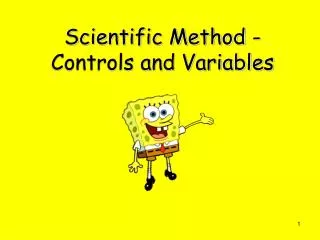
Variables are conditions that can affect the outcome of an experiment. Some variables are held constant in all experimental set ups. They are called controls. Two special variables exist in experiments: • Independent (aka “manipulated”) • Dependent (aka “responding”) The Variables
The independent variable is the ONE that the scientist changes in the set up. It is the “if …” part of the hypothesis. “If a plant is grown with fertilizer …” The Independent Variable
The dependent variable is the one that will be measured during the experiment. It is the “then …” part of the hypothesis. “… then it will grow taller …” The dependent variable
Make a logical connection between the independent and dependent variables. • “… because the plants will receive more nutrients.” The reasoning
Clear, logical procedure • Should be easy to follow and repeat by another scientist • Include a validity measure • A step in the process that makes your data more genuine • Make reference to “repeating” the process • Repeated trials help make data more accurate • Also reduces the effects of any possible errors Designing an experiment
Hypothesis formed in “If … then … because …” • Only ONE variable changed in experiment • Independent variable • Dependent variable is affected by the independent variable • Experimental Design • Clear procedure • Validity measure • Repetition KEY POINTS to Remember …