Carbohydrates
110 likes | 244 Vues
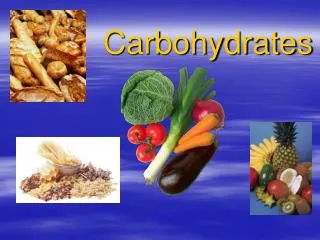
This overview on carbohydrates explains their basic structure (Cx(H2O)y) and their classification into monosaccharides, disaccharides, oligosaccharides, and polysaccharides. Monosaccharides, like glucose and fructose, are the simplest form, while disaccharides such as sucrose consist of two sugar units. Oligosaccharides contain 2-10 units, whereas polysaccharides like starch and cellulose are complex carbohydrates. Additionally, this resource highlights the importance of carbohydrates in our diet, their role in energy provision, and common sources.


Carbohydrates
E N D
Presentation Transcript
Carbohydrates Rishika Singh and Amy Hu
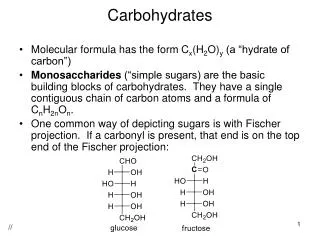
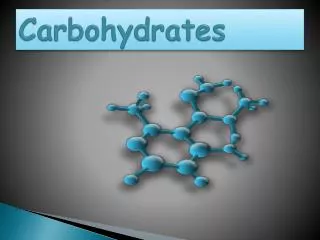
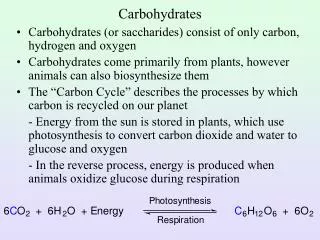
Carbohydrates • Cx(H2O )y • carbon along with hydrogen and oxygen in the same ratio as water (C:H:O of 1:2:1) • Basic unit – monosaccharide • Multiple units – • disaccharide (2) • trisaccharide (3) • oligosaccharide (2-10) • polysaccharide (>10)
Sugars • Simplest carbohydrates • Monosaccharides: most common sugars in foods and can not be broken down further by hydrolysis o Most common ones in foods are hexoses or six-carbon sugars o Occuring in nature: glucose, mannose, galactose, fructose, and sorbose
Sugars • Disaccharides: composed of two units of monosaccharides, can be two of the same or two different Ex: • Lactose (glucose and galactose) • Maltose (glucose and glucose) • Sucrose (carbon 1 of glucose linked to carbon 2 of fructose)
Sugars • Oligosaccharides: have between 2-10 monosaccharide units • Different sugars have different levels of sweetness • 4 Kcal/gram • reducing sugar: type of sugar with ketone or aldehyde group
Sugars • Polysaccharides • Examples: • Starch - glucose polymers, found in plants • Cellulose - found in plant fibers, insoluble • Pectin - units are sugar acids rather than simple sugars, found in • vegetables and fruits • Branched vs. linear • Starches are a mixture of branched (amylopectin) and linear • (amylose) polysaccharides
Starches • Polymer of glucose • Composed of amylose (linear compound) and amylopectin • (branched compound) – plant based • 4 Kcal/gram • not readily soluble in cold • water but when heated swell • and gelatinize b/c of water uptake
Starches • Starches are a long complex chain of simple sugars • Starches are carbohydrates with a large number of glucose units joined together by glycosidic bonds • Is in large amounts in staple foods like potatoes
Starches • Cellulose can not be digested by humans (b/c of bonds) • Glycogen: animal starch that is highly branched glucose • units • Fibers: non-digestible carbohydrates • Cellulose, pectin, and gums
Plant Gums • water-soluble, nonstarch polysaccharides of commerce; • such gums are present in both higher and lower plants. Plant gums and other gums are used in practical applications primarily to thicken or gel aqueous systems and to control water. • May also function as adhesives, crystallization inhibitors, emulsifying agents, emulsion stabilizers, encapsulating agents, film formers, foam stabilizers, suspending agents, suspension stabilizers, or syneresis inhibitors and/or impart other specific properties.