Understanding Nutritional Components for Optimal Fish Growth and Health
This overview examines the critical role of basic nutrients—proteins, lipids, carbohydrates, vitamins, and minerals—in fish diets. It addresses the importance of proper protein balance with energy for efficient growth, discusses essential amino acids, lipid sources, and carbohydrate utilization. Emphasis is placed on understanding dietary energy partitioning, feed efficiency ratios, and the impact of these factors on weight gain in aquaculture. By identifying nutrient requirements and optimizing feeding regimes, we can enhance fish health and performance in aquaculture systems.

Understanding Nutritional Components for Optimal Fish Growth and Health
E N D
Presentation Transcript
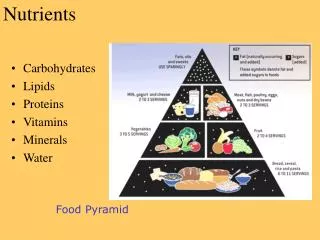
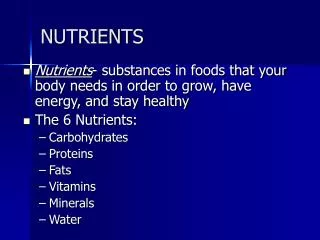
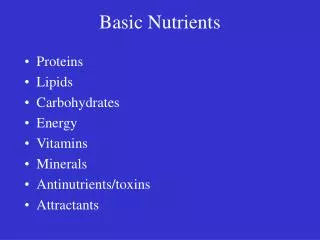
Basic Nutrients • Proteins • Lipids • Carbohydrates • Energy • Vitamins • Minerals • Antinutrients/toxins • Attractants
Proteins • Most expensive feed component • Utilization varies—animal vs plant protein • Major source of nitrogen in effluents • Must be balanced with energy
Protein Requirements • Important due to implications in feeding costs and effluents • Must be established with small rapidly growing fish • Requirements decrease with increasing size of fish
Protein Studies • Minimum requirement studies • Individual amino acid requirements • Feeding regimes--metabolic studies • Alternate protein sources--palatibility, attractability
Weight Gain-Protein Requirement ** 35 40 45 ** % Dietary Protein Serrano et al., 1992
Weight Gain--Metabolic Study Weight gain (g) 0 1.8 3.6 7.3 14.6 21.9 29.2 g digestible protein/kg bw/day McGoogan and Gatlin, 1998
Amino Acid Requirements • Must be met to ensure maximum weight gain and health • Deficiency symptoms—reduced weight gain, amino acid specific symptoms • Methionine and lysine usually most limiting • Studies involve feeding diets containing graded levels of test amino acid • Data usually fitted to regression analysis or broken line method to determine requirement
Lysine Requirement—Red Drum % initial wt
Methionine Requirement—Red Drum % initial wt
Lipids Efficient energy source Essential fatty acids Phospholipids, steroids, prostaglandins Deposition
Lipid Deposition • Excessive deposition--inefficient energy utilization • Physiological/health concerns—oxidation of membrane lipids • Final product quality
Lipid Studies • Inclusion level • Essential fatty acids • Alternate lipid sources
Lipids--Indicators • Weight gain • Intraperitoneal fat (IPF) ratio • Enzymatic/biological indices
Weight Gain--Lipid Requirement % initial wt. 1.7 4.0 11.2 15.0 18.8 7.4 % Dietary Lipid Williams and Robinson, 1988
Weight Gain--Lipid Study % initial wt. a ab ab b 0.5 7 14 21 % Dietary Lipid
IPF Ratio--Lipid Study IPF wt. x 100/body wt. a ab b c 0.5 7 14 21 % Dietary Lipid
Lipids--Essential Fatty Acids • Certain fatty acids necessary for normal growth and health--n-6 and n-3 • Important implications for human health • Marine lipids high in n-3 fatty acids,
Lipids--Essential Fatty Acids • Freshwater fish usually require linoleic (18:3n-3)--chain elongation:channel catfish • Marine fish usually require EPA and DHA--no chain elongation • Other fish--tilapia require n-6, eels, chum salmon, carp require mixture n-3 and n-6
Dietary Lipid Sources Characteristic Source Menhaden oil High HUFA Corn oil High 18:2n-6 Coconut oil High 12:0,14:0 Beef tallow High 16:0, 18:0 Soy oil High 18:1 Tricparylin High 8:0
Weight Gain--Alternate Lipid Sources % initial wt. a b b c c Menhaden Coconut Corn MCT2 MCT1 Dietary Lipid
Weight Gain-Sea Grant % initial wt. Men Coco Soy Tallow Lec 14% Men Coco2 Dietary Lipid
MDA levels--Lipid Study nmoles/ g liver a ab b b 0.5 7 14 21 % Dietary Lipid
Carbohydrates • Inexpensive energy source • Variable utilization--species dependent • Binding agents-extrusion
Weight Gain of Hybrid Striped BassCHO/Lipid Study % initial wt. 25/10 31/7.5 36/5 42/2.5 Nematipour et al., 1992 CHO/Lipid Ratio
IPF Ratio of Hybrid Striped BassCHO/Lipid Study IPF wt. x 100/body wt. a ab bc c 25/10 31/7.5 36/5 42/2.5 Nematipour et al., 1992 CHO/Lipid Ratio
Energy • Growth • Maintenance • Reproduction
Energy Units • Joules (J)- the metric measure of energy, the energy expended in accelerating 1 gram by 1 cm/s • calorie (cal) - the traditional measure or energy, the amount of energy to raise the temperature of 1 gram of water from 16.5°to 17.5° C; 1000 calories=1 kcal • 1 cal=4.184 Joules
Partitioning of Dietary Energy Intake energy Excretory loss fibrous materials Digestible Energy Gill/urine excretion Metabolizable Energy Heat increment Digestion/absorption Waste formation Net Energy Maintenance Activity Recovered Energy Growth, Fat deposition, Reproduction
Energy Advantages of Fish • Heat increment lower than birds and mammals--excrete ammonia vs urea/uric acid • Maintenance energy lower—do not regulate body temperature • Gravity—smaller portion of energy spent for voluntary or resting activity
Energy:Protein Ratios • Proper balance for maximum weight gain • Low E:P ratio--reduced weight gain • High E:P ratio--increased lipid deposition; reduced feed consumption
Weight Gain of Hybrid Striped BassEnergy/Protein Ratio Study % initial wt. a ab ab bc cd d 6 7 8 9 10 11 Energy/Protein Ratio Nematipour et al., 1992 (kcal/g protein)
IPF Ratio of Hybrid Striped BassEnergy/Protein Ratio Study IPF wt. x 100/body wt. a ab b c c c 6 7 8 9 10 11 Energy/Protein Ratio Nematipour et al., 1992 (kcal/g protein)
Feeding Assessment Feed Efficiency Ratio (FER) = wt gain/ wt feed offered x 100 higher numbers better efficiency Feed Conversion Ratio (FCR) = wt feed offered/wt gain lower numbers better efficiency
Feeding Assessment • Typical “good” FCR’s for fish range from 1.5 to 1.8 (FER = 66 to 55%) • Poultry also good converters, FCR’s of 2 (FER= 50%) • Pigs and cattle higher, FCR’s ranging from 6-10 (16 to 10%)
Finishing/Specialty Feeds • Another area of little research • Could prove important for enhancing final product quality • Seasonal feeds to maximize weight gain under different environmental conditions • Marketing--high levels of n-3??
Median Lethal Temperatures o C a b b bc c Coconut Sat Men Corn Men 14 Men Dietary Lipid
n-3 HUFA Levels-Cold Tolerance g/100g Coconut Sat Men Corn Men 14 Men Dietary Lipid