SlideServe
Menu
Préférences
© SlideServe · v2026

The Power of Wisdom: Agreeing with the Quote "There is no happiness where there is no wisdom"

metta avatar
14 diapositives · 269 Views · Jul 23, 2014

In the exploration of happiness as portrayed in the play, the quote "There is no happiness where there is no wisdom" resonates deeply. Wisdom shapes our understanding of ourselves and the world, influencing our choices and emotional well-being. I wholeheartedly agree with this statement, as wisdom enables us to navigate life's complexities, leading to greater fulfillment and joy. When we lack wisdom, we risk making poor decisions, which can result in unhappiness. Thus, the cultivation of wisdom is essential for genuine happiness and a meaningful life.
The Power of Wisdom: Agreeing with the Quote "There is no happiness where there is no wisdom" - slide 1
01 / 14The Power of Wisdom: Agreeing with the Quote "There is no happiness where there is no wisdom"
1 / 17

Télécharger la présentation

The Power of Wisdom: Agreeing with the Quote "There is no happiness where there is no wisdom"
Une image / un lien ci-dessous est fourni (tel quel) pour télécharger la présentation

Politique de téléchargement : le contenu du site vous est fourni TEL QUEL pour votre information et votre usage personnel ; il ne peut être vendu, concédé sous licence ni partagé sur d’autres sites sans l’accord de son auteur.Le contenu vous est fourni TEL QUEL, pour votre information et votre usage personnel uniquement. Téléchargez la présentation en cliquant sur ce lien. Lors du téléchargement, si vous ne parvenez pas à télécharger une présentation, l’éditeur a peut-être supprimé le fichier de son serveur.Pendant le téléchargement, si vous ne parvenez pas à obtenir une présentation, le fichier a peut-être été supprimé par l’éditeur.

F I N

Plus de contenu associé

Transcription de la présentation
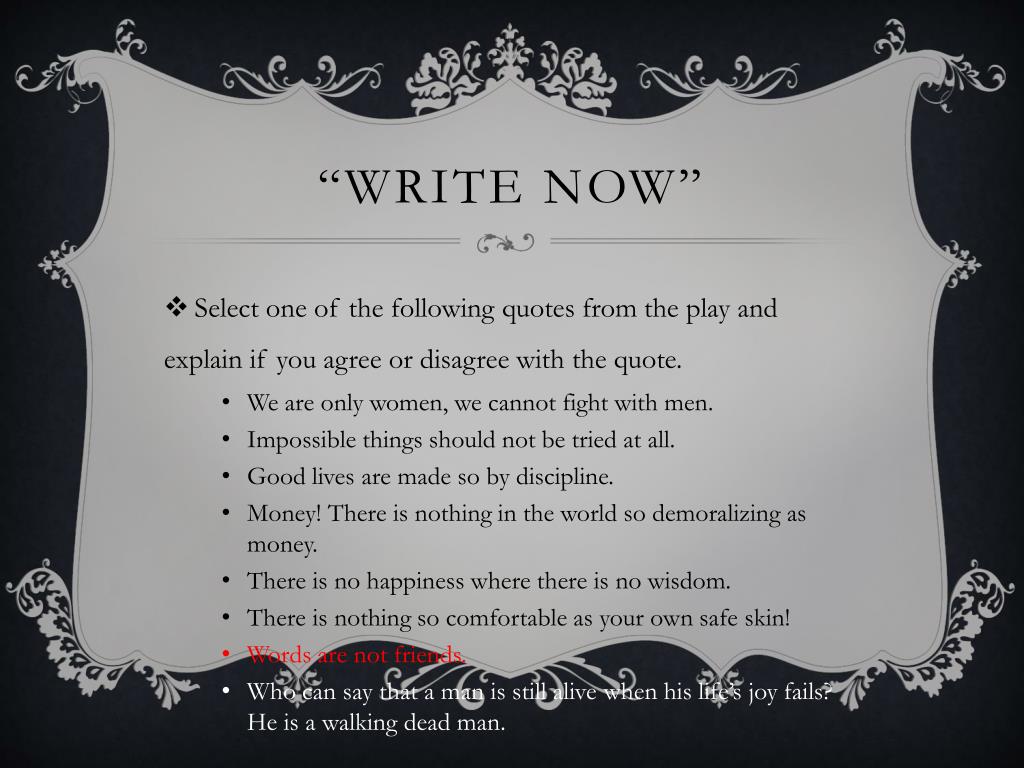
  1. “Write now” • Select one of the following quotes from the play and explain if you agree or disagree with the quote. • We are only women, we cannot fight with men. • Impossible things should not be tried at all. • Good lives are made so by discipline. • Money! There is nothing in the world so demoralizing as money. • There is no happiness where there is no wisdom. • There is nothing so comfortable as your own safe skin! • Words are not friends. • Who can say that a man is still alive when his life’s joy fails? He is a walking dead man.

  2. Tragedy Aristotle

  3. Imitation of an action • Replicating an original action, feeling, or item. • Serious moral implications • Not limited to one character; an entire action

  4. A Play: The Necessary Medium • Play = One Day • People can come together to experience the same emotions

  5. Purpose • Catharsis (i.e. the purging of strong emotions or relieving of emotion tensions, especially through certain kinds of art) • Watch the play • Feel the emotions (fear, pity, sympathy, etc.) • Purging of emotions • Play = controlled environment • Better together than alone

  6. Unity! • Action – simple plot; no subplots • Time – no more than 24 hours • Place – Cover one physical space

  7. Stages of the Tragic Hero

  8. The Tragic Hero • Better than the average person • Good fortune to Bad Fortune

  9. Hamartia • Change that comes or a mistake that the hero makes. • Change DOES NOT have anything to do with the god’s or divine will. • Change depends SOLELY on the free will of the hero.

  10. Peripety • The action performed by the tragic hero accomplishes the OPPOSITE of the action’s intent.

  11. Recognition • The hero must realize that his/her actions have created their own bad present or future. • Recognition comes by their own reasoning! • Cannot be through means of other people (a letter, a character telling them, etc.); needs to be a real change of belief

  12. pathos • Last item for the tragic hero • Destructive or painful act that the character experiences (e.g. death, stabbing eyes out, etc.) • This final emotion/action is necessary for the hero to be considered tragic.

  13. What the tragic hero is noT! • Person from good moral figure to bad moral figure. • No fear or pity is created • Morally repugnant • Wicked person from bad to good fortune • Least tragic of all • Does not evoke sympathy, fear, or pity • No reason for a wicked person to have good fortune if the goal is to purge oneself of negative emotions. • Wicked person from good fortune to bad fortune • Creates sympathy (good) • Does not create fear or pity (bad)

  14. Who is the tragic hero? • Directions: • First, decide who the tragic hero of the play is. • Second, make of list of how the character fits all four stages of the tragic hero.