The Rise and Cultural Impact of Islam (570 A.D. – 1250 A.D.)
The Islamic world from 570 A.D. to 1250 A.D. showcases the profound transformation in Arabia and beyond. Emerging from a harsh desert landscape, nomadic Arabs transitioned from herding to caravan trading, culminating in the birth of Islam through the Prophet Muhammad's revelations. The faith, rooted in monotheism and equality, spread rapidly through the Middle East and Africa, influencing various aspects of culture including medicine, geography, and architecture. Islamic teachings on social justice and equality left a lasting legacy, shaping societies across continents.

The Rise and Cultural Impact of Islam (570 A.D. – 1250 A.D.)
E N D
Presentation Transcript
The Islamic World 570 A.D. – 1250 A.D.
Arabia • Arabian peninsula is mostly a harsh desert, with little water
Arabia (cont) • Arabs were nomadic herders • Leader of tribe was the sheik • Later became caravan traders
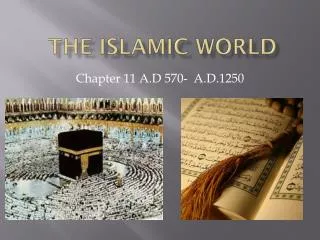
Origin of Islam • Arabs were polytheistic • Believed they descended from Abraham • His son, Ishmael, built a temple in Mecca • The cornerstone of the Kaaba is called the black stone
Origins (cont) • Muhammad (570 A.D.-632 A.D.) • Prophet, who received visions from the angel Jibreel (Gabriel) • Taught that there was one God, Allah • Destroyed the idols in the Kaaba and rededicated to Allah
Islamic Faith • There is one God, Allah • Qur’an is the holy book of Islam • Muslims worship in Mosques
as equal to the prophets a belief in one God It says to accept them.
Spread of Islam • Easy to learn and practice • No priesthood • Teaches equality • Easily “portable” nomads & trade routes
Spread of Islam (cont) • Jihad means to strive or struggle • Military extension of Islam • Only warfare permitted • Some Muslims believe this is the “sixth pillar”
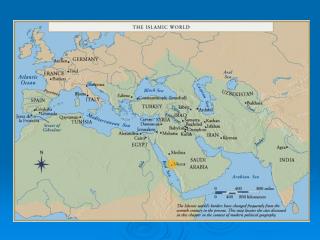
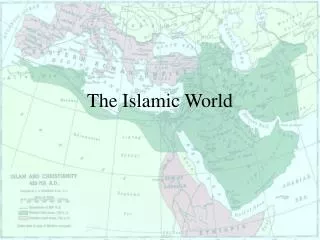
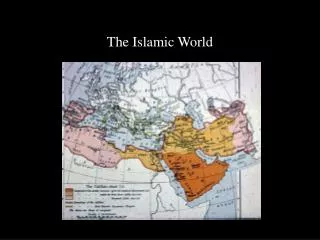
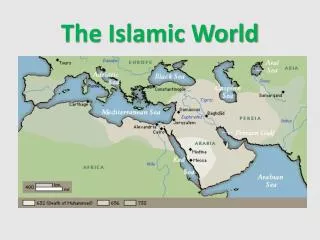
Spread of Islam (cont) • Within 100 years of Muhammad’s death, Islam spread throughout the Middle East and Africa • The Moors controlled Spain • The Turks later controlled much of Asia Minor and part of India
500 years A.D. 680 the Umayyad dynasty
The Divide • When the third caliph’s successor was murdered a split occurred • Sunnis believe agreement among Muslims should settle religious matters • Sh’iah believe that imams should decide religious matters
Culture • Marriage • Women could refuse an arranged marriage • Women could keep property after a divorce • Qu’ran limits a man to four wives
Culture (cont) • Slavery • Qu’ran encourages Muslims to free their slaves • Slaves are to be treated humanely • Free Muslims could not be enslaved • Children of a female slave and her master were free
Culture (cont) • Medicine • Studied anatomy • Established first pharmacy school and encyclopedia • Spread knowledge to Europe Avecinna, father of modern medicine Anatomy of the eye
Culture (cont) • Geography • Cartography • Developed extremely accurate maps • Astronomy • Used astrolabe to navigate the stars
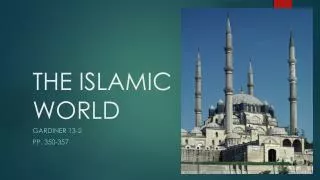
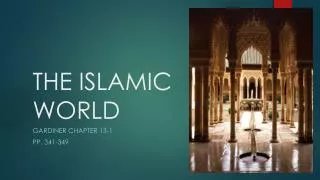
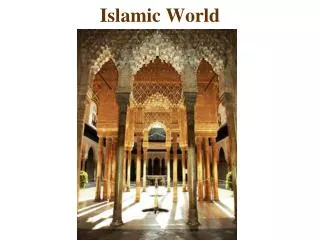
Culture (cont) • Architecture was designed to show the glory of Islam • Mosques have a minaret on top • A crier calls the people to worship five times a day
Culture (cont) • The Arts (cont) • Great patrons of poetry and literature • The Thousand and One Nights • Ali Baba, Aladdin, Sinbad
algebra the astrolabe architecture