Understanding Optical Tweezers: Principles, Applications, and Safety Guidelines
200 likes | 309 Vues
This presentation explores the innovative technique of Optical Tweezers, currently not included in Advanced Physics Labs. Designed for educators and students, it highlights apparatus setup, practical applications, and essential safety procedures involving laser technology. Participants will gain insights into energy equipartition theory and relevant experiments, enhancing their laboratory skills in engineering and science. The presentation aims to guide informed decisions for students considering this challenging yet fascinating method of manipulating microscopic objects.


Understanding Optical Tweezers: Principles, Applications, and Safety Guidelines
E N D
Presentation Transcript
Optical Tweezers Team: MaryamBadakhshi, Shannon O’Keefe, Laura Poloni, Hasmita Singh
Overview • 1) Introduction • 2) Background & Applications • 3) Apparatus • 4) Laser Safety
Experiment Context • Optical Tweezers are a brand new experiment • Not currently part of Advanced Physics Labs • Purpose of presentation: • TA/Instructor to deliver a brief presentation to students • Apparatus • Applications • Hazards • Safety procedures • Students can make an informed decision regarding choosing an experiment
Relevant Courses • Theory behind Experiment: • Energy Equipartition theory • Relates to courses in both Engineering and Arts and Science: • Phy293 Engineering • PHY256H1 Arts and Science • This lab is designed for the Advanced Physics Labs: • PHY424/426/428/429 (A&S) and PHY327/427/428/429 (Engineering)
Experiment Learning Objectives • Students will have the opportunity to : • Work on interesting and challenging experiments • Deepen their understanding of the underlying Physics • Further develop laboratory, analysis and communication skills • Gain familiarity with the Optical Trapping apparatus and its various applications
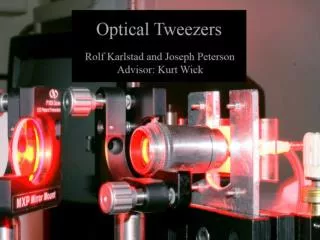
Optical Tweezers • Highly focused laser beam is used to physically hold and move microscopic dielectric objects • Can manipulate objects with noncontact and direct trapping • Advanced Physics Laboratory for the Optical Tweezers apparatus involves the determination of optical trap stiffness of silica beads through various methods Public image by RockyRoccon 2007
Manipulation of Nanodevices • Four spheres trapped and rotated by linearly scanning with laser light (Tong et. al., Nano Letters, 2010) (Nam et. al., IJPEM, 2009) • Alignment and rotation of a silver nanowire
Isolation and Visualization of DNA Staining with Fluorescent Dye Force-Extension analysis of the trapped DNA “Catching” a Single DNA Molecule Trapping of two beads (Gross et. al., Methods in Enzymology, 2010) (Gross et. al., Methods in Enzymology, 2010) Protein-coated DNA region Fluctuations in DNA molecule
MainComponents Very Dangerous! Safe!
Optical Trap Laser Characteristics • 980 nm Infrared range • 330mW maximum power • Collimated beam • Class 3B laser
Laser Classification • Considered incapable of causing injury • Hazardous under direct and specular reflection, but not diffuse reflection • Direct exposure to beam is an eye hazard • Maximum power 500mW
Hazards • Diffuse reflections • Invisible • Most dangerous procedure, contact your TA/Instructor • Eye injuries without laser safety glasses Stray Beams Beam Alignment Biological Effects
Biological Effects • Cornea • Focussing element • Lens • Fine focus • Vitreous Humor • Retina • Image is projected from the cornea and lens • Connection to brain through optic nerve • Fovea • Sharp vision
Biological Effects Retinal Hazard Region • Laser Light 400-1400nm • Focussed beam on retina • Amplification of light by human eye: 10,000 • Extremely large irradiance • Dependent on exposure time Thermal Effects • Overheating • Retina burns • Scars / blind spots in the field of vision • Invisible light: damage may only be detected post-injury • Severe damage may require surgery or transplant • Depending on location of the burn, could permanently lose: • Central vision • Peripheral vision
Laser Hazards Control • Place “Laser Work in Progress” warning sign on door • Close and lock the room door • Remove wristwatches or reflective jewellery • Wear laser safety glasses AT ALL TIMES • - Wavelength and Optical Density • If someone unexpectedly enters, turn laser off • Turn off laser when changing samples • Return the laser controller key when completed • In case of an emergency, contact your TA/Instructor or UofT Campus Police 416-978-2222