
Mastering Chemical Equation Balancing: A Comprehensive Guide to Conservation of Mass
E N D
Presentation Transcript
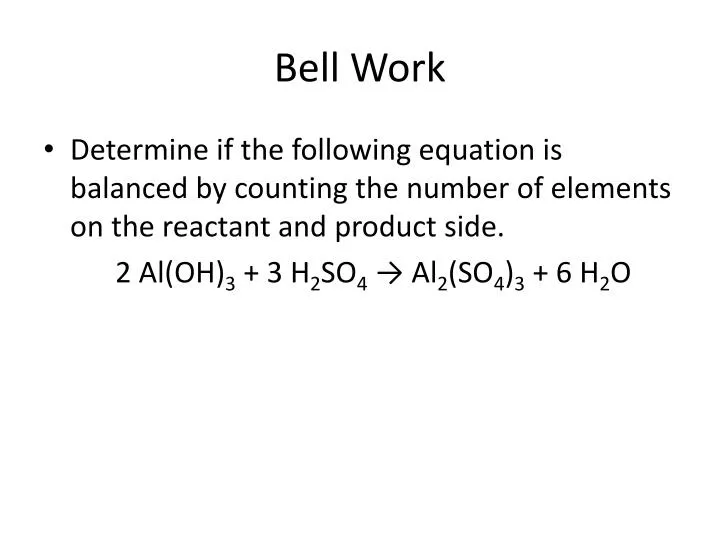
Bell Work • Determine if the following equation is balanced by counting the number of elements on the reactant and product side. 2 Al(OH)3 + 3 H2SO4 → Al2(SO4)3 + 6 H2O
Physical Science – Lecture 47 Balancing Equations
Law of Conservation of Mass • Law of Conservation of Mass says that in a chemical reaction, the mass of the products equals the mass of the reactants. • The number of each element (not compound) on each side must be equal since mass cannot be created or destroyed.
How do we count elements in equations? • Multiply the coefficient times the subscript for each element in a chemical formula. • If the chemical formula has parenthesis, the subscript outside the parenthesis is also multiplied by all elements inside the parenthesis.
Practice • CaCO3
Practice • Ca3(PO4)2
Practice • 3(NH4)3PO4
Practice • 4 FeI3
Practice • 2 Mg(NO3)2
Practice • 4 Be3(PO4)2
Balancing an Equation Rules • Apply the Law of Conservation of Mass to get the same number of atoms of every element on each side of the equation.
How to Balance an Equation • Step 1 - Draw a chart with elements from the reactant side on the left and elements from the product side on the right. (If one element appears in more than one formula, place the element in two separate blocks). • Step 2 – Identify the elements that are unbalanced. • Step 3 –Multiply each unbalanced element by any number that will make the two sides (reactant and product) equal. • Step 4 - When multiplying, if an element is in the same chemical formula as another, you must also multiply that element by the same number.
Why can’t we adjust the number of elements by changing the subscripts?
Why can’t we adjust the number of elements by changing the subscripts? • Balance chemical formulas by placing coefficients in front of them. Do not add subscripts, because this will change the chemical formulas.
Practice – Is it Balanced? • 3 Mg + N2→ Mg3N2
Practice – Is it balanced? • 3 Fe + 4 H2O → Fe3O4+ 4 H2
Practice- Is it balanced? • 4 H2O2→ 2 H2O + 3 O2
Practice – Is it Balanced? • 2 Fe + 3 O2→ 2 Fe2O3
Example – Balancing an Equation • Find the missing number to balance the equation: • 2 FeCl3 + 1 Be3(PO4)2 --> ___ BeCl2 + 2 FePO4
Practice – Balancing an Equation • Find the missing number to balance the equation: • ___ CH4+ 2 O2 --> 1 CO2 + 2 H2O
Practice – Balance the Equation • Find the missing number to balance the equation: • 2 Al + ___ HCl → 2 AlCl3+ 3 H2
Practice – Balance the Equation • Find the missing number to balance the equation: • 6 CO2+ 6 H2O → 1 C6H12O6+ ___ O2
Example – Balance the Following Equation • Al + O2 → Al2O3
Example – Balance the Following Equation • N2+ O2→ N2O
Example – Balance the Following Equation • Mg + O2 → MgO
Practice - Balance the Following Equation: • Al + CuO → Al2O3 + Cu
Practice - Balance the Following Equation: • HgO → Hg + O2
Practice - Balance the Following Equation: • K2O + H2O → KOH
Practice - Balance the Following Equation: • Mg + P4 → Mg3P2
Practice - Balance the Following Equation: • CaCl2 + AgNO3 → AgCl + Ca(NO3)2