Nouns
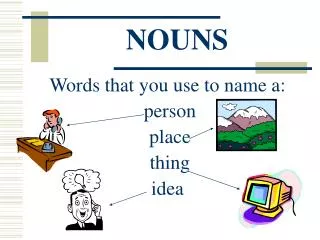
Nouns. WHAT ARE NOUNS?. Nouns are naming words. They name people, places and objects. They can also name ideas, emotions, qualities and activities. Here are some examples of nouns: Peter, Elizabeth, driver, sister, friend. Bristol, Severn, Brazil, pen, dog, money.

Nouns
E N D
Presentation Transcript
WHAT ARE NOUNS? • Nouns are naming words. • They name people, places and objects. • They can also name ideas, emotions, qualities and activities. • Here are some examples of nouns: • Peter, Elizabeth, driver, sister, friend. • Bristol, Severn, Brazil, pen, dog, money. • Love, beauty, industry, nature, greed, pain.
Typesof nouns • All nouns can be divided into common and proper nouns. • Common nouns can then be divided into concrete and abstract nouns. • There are also collective nouns
First, look again at those types and how they relate. proper nouns abstract common concrete
Proper nouns • Proper nouns start with capital letters. • They are the names of people, places, times, organizations etc. • They refer to unique individuals. • Most are not found in the dictionary.
Common nouns • All nouns which are not proper nouns are common nouns. • A few examples: cup, art, paper, work, frog, bicycle, atom, family, mind. • Common nouns are either countable or uncountable.
Concrete nouns • Concrete nouns are the words that most people think of as nouns. • They are mostly the names of objects and animals (countable) and substances or materials (uncountable). • Cake, oxygen, iron, boy, dog, pen, glass, pomegranate, earthworm and door are all concrete nouns.
Abstract nouns • Abstract nouns name ideas, feelings and qualities. • Most, though not all, are uncountable. • Many are derived from adjectives and verbs and have characteristic endings such as –ity, -ness, -ence, and -tion. • They are harder to recognise as nouns than the concrete variety.
Abstract noun or adjective • You won’t confuse abstract nouns with adjectives, as long as you apply a few tests. • Happy is an adjective. It behaves like one: very happy; so happy; happier; as happy as • Happiness behaves like a noun: The happiness I feel; her happiness; great happiness.
A few more examples Verb or adjective Abstract noun We were different from each other. The difference between us. My work is precise. I work with precision. The air is pure. The purity of the air. I composed this tune. This tune is my composition. It is so beautiful. It has such beauty. You support me. The support you give me.
Collective Nouns • Collective nouns are words that have a singular form but name a group of persons, animals, or objects that are considered in a single unit. • Examples: • The crowd surrounded him. • The car paused as the herd crossed the road. • The audience laughed as the comedian presented his funniest story.