Download
1 / 6
60 likes | 174 Vues
The pursuit of the Northwest Passage drove England, France, and the Netherlands to explore North America. Henry Hudson, sailing for the Dutch, ventured up the Hudson River, believing in a shortcut to Asia that fueled explorations well into the early 1800s. Economic rivalries in the fur trade intensified competition, leading to alliances with Native Americans and conflict among tribes like the Iroquois and Hurons. The Protestant Reformation added a religious dimension to colonization, affecting European and Native American dynamics. Claims were made from the Atlantic Coast to Canada, reshaping the continent's future.

E N D
Colonizing North America England, France and Holland Join the Race
Northwest Passage • Waterway through North America • Henry Hudson – sailing for the Dutch- sailed up Hudson River in search of NW Passage • Belief in NW passage continued into the early 1800s. Lewis and Clark sent to explore Louisiana Territory in search of NW passage – discovered the Rocky Mts.
Economic Rivalries • French and Dutch rivals in the fur trade. • English and Dutch competing for land in N.America • Both sides made alliances with Native Americans
Religious Rivalries • Protestant Reformation = split within Catholic Church. Protestant Church formed • France and Spain = Catholic Nations • England and Netherlands = Protestant
Impact on Native Americans • Rivalry in fur trade increased warfare amongst tribes such as the Iroquois and Hurons • Disease spread • Converted to Christianity • Alcohol introduced
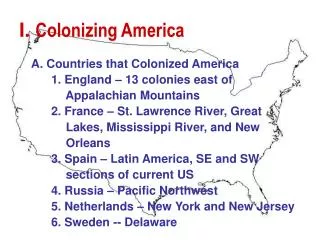
Europe in the Americas • England, France, and Netherlands claim lands in N.America • Dutch – Mid Atlantic • French – Canad • English – Atlantic Coast • Spain – South America and SW North America • Portugal - Brazil