Engaging K-12 Students in STEM: The Launch Tube Experiment by Cornell Faculty
10 likes | 143 Vues
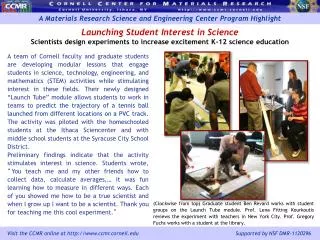
A dedicated team of Cornell faculty and graduate students is revolutionizing K-12 science education through an innovative program designed to stimulate excitement in STEM fields. Their newly developed “Launch Tube” module provides students with hands-on experience in designing experiments. By predicting the trajectory of a tennis ball launched on a PVC track, students work in teams, enhancing their understanding of data collection and scientific principles. Preliminary findings from pilot programs suggest enhanced interest in science, with students expressing a desire to pursue careers in the field.


Engaging K-12 Students in STEM: The Launch Tube Experiment by Cornell Faculty
E N D
Presentation Transcript
Launching Student Interest in Science Scientists design experiments to increase excitement K-12 science education A team of Cornell faculty and graduate students are developing modular lessons that engage students in science, technology, engineering, and mathematics (STEM) activities while stimulating interest in these fields. Their newly designed “Launch Tube” module allows students to work in teams to predict the trajectory of a tennis ball launched from different locations on a PVC track. The activity was piloted with the homeschooled students at the Ithaca Sciencenter and with middle school students at the Syracuse City School District. Preliminary findings indicate that the activity stimulates interest in science. Students wrote, “You teach me and my other friends how to collect data, calculate averages,… It was fun learning how to measure in different ways. Each of you showed me how to be a true scientist and when I grow up I want to be a scientist. Thank you for teaching me this cool experiment.” (Clockwise from top) Graduate student Ben Revard works with student groups on the Launch Tube module. Prof. Lena Fitting Kourkoutis reviews the experiment with teachers in New York City. Prof. Gregory Fuchs works with a student at the library. Visit the CCMR online at http://www.ccmr.cornell.edu Supported by NSF DMR-1120296