
Purification and Characterization of High Molecular Weight Dsp Proteins via RP-HPLC and SDS-PAGE

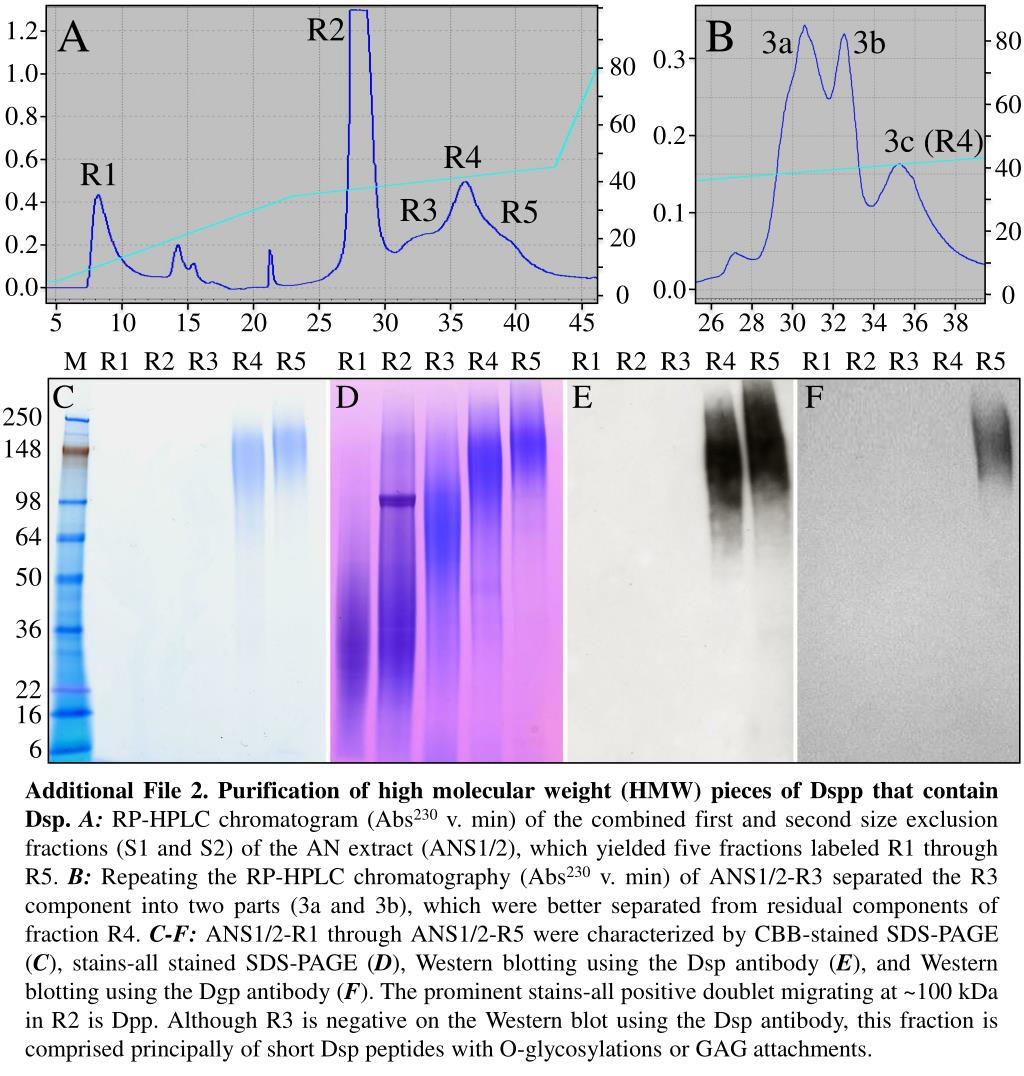
This study outlines the purification process of high molecular weight (HMW) components of Dsp using RP-HPLC. The procedure involved multiple size exclusion fractionations, yielding five distinct fractions (R1-R5) for further analysis. The RP-HPLC chromatography of combined fractions revealed effective separation of components, particularly highlighting the distinct characteristics of each fraction through CBB-stained SDS-PAGE, stains-all, and Western blotting with Dsp and Dgp antibodies. Notably, fraction R2 exhibited a prominent doublet at ~100 kDa, indicative of Dpp, while R3 was primarily composed of short Dsp peptides.
Télécharger la présentation 
Politique de téléchargement : le contenu du site vous est fourni TEL QUEL pour votre information et votre usage personnel ; il ne peut être vendu, concédé sous licence ni partagé sur d’autres sites sans l’accord de son auteur.Le contenu vous est fourni TEL QUEL, pour votre information et votre usage personnel uniquement. Téléchargez la présentation en cliquant sur ce lien. Lors du téléchargement, si vous ne parvenez pas à télécharger une présentation, l’éditeur a peut-être supprimé le fichier de son serveur.Pendant le téléchargement, si vous ne parvenez pas à obtenir une présentation, le fichier a peut-être été supprimé par l’éditeur.
F I N