
SlideServe
Menu
Préférences
© SlideServe · v2026

Exponential Smoothing

munin avatar
2 diapositives · 467 Views · Aug 10, 2014

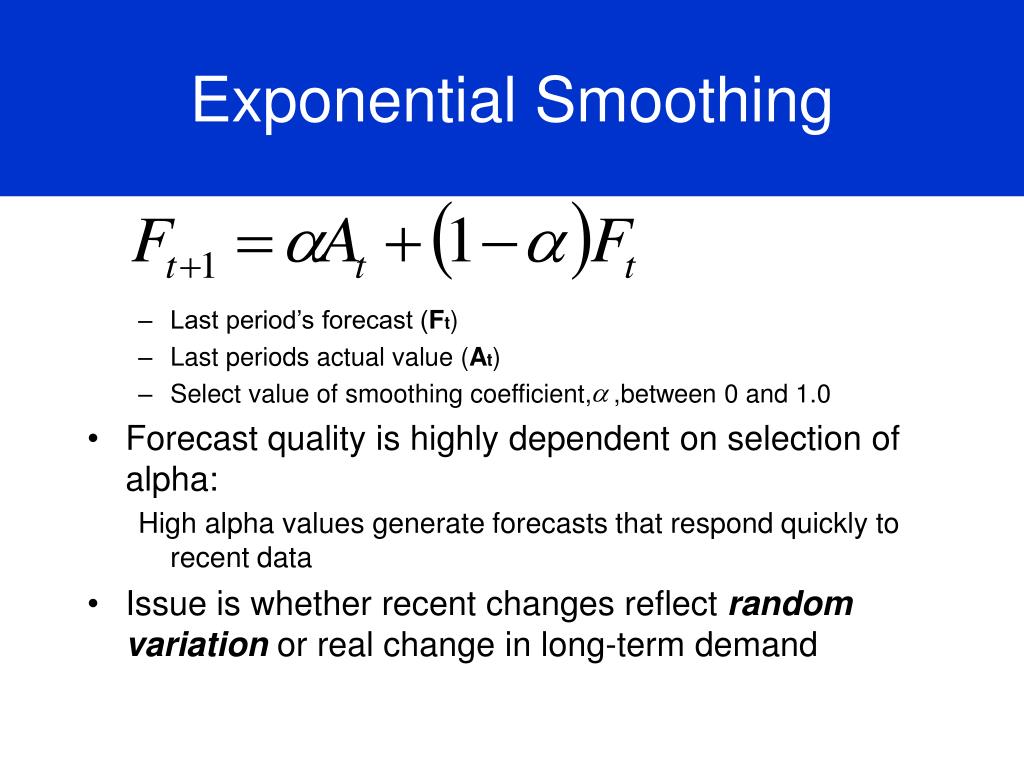
Exponential Smoothing. Last period’s forecast ( F t ) Last periods actual value ( A t ) Select value of smoothing coefficient, ,between 0 and 1.0 Forecast quality is highly dependent on selection of alpha: High alpha values generate forecasts that respond quickly to recent data
Exponential Smoothing - slide 1
01 / 2Exponential Smoothing
1 / 17

Télécharger la présentation

Exponential Smoothing
Une image / un lien ci-dessous est fourni (tel quel) pour télécharger la présentation

Politique de téléchargement : le contenu du site vous est fourni TEL QUEL pour votre information et votre usage personnel ; il ne peut être vendu, concédé sous licence ni partagé sur d’autres sites sans l’accord de son auteur.Le contenu vous est fourni TEL QUEL, pour votre information et votre usage personnel uniquement. Téléchargez la présentation en cliquant sur ce lien. Lors du téléchargement, si vous ne parvenez pas à télécharger une présentation, l’éditeur a peut-être supprimé le fichier de son serveur.Pendant le téléchargement, si vous ne parvenez pas à obtenir une présentation, le fichier a peut-être été supprimé par l’éditeur.

F I N

Plus de contenu associé

Transcription de la présentation
  1. Exponential Smoothing • Last period’s forecast (Ft) • Last periods actual value (At) • Select value of smoothing coefficient, ,between 0 and 1.0 • Forecast quality is highly dependent on selection of alpha: High alpha values generate forecasts that respond quickly to recent data • Issue is whether recent changes reflect random variation or real change in long-term demand

  2. Selecting Appropriate Value of Smoothing Constant • The larger the value of alpha the more sensitive the forecast will be to the current demand • Use low value of alpha when demand data has high variability (i.e. up & down) • Use larger value of alpha when demand data has low variability • Alpha should probably be between 0.01 and 0.30 – higher value may place too much value on last period’s actual random variation