
Uploaded by
murray
73 SLIDES
835 VUES
730LIKES
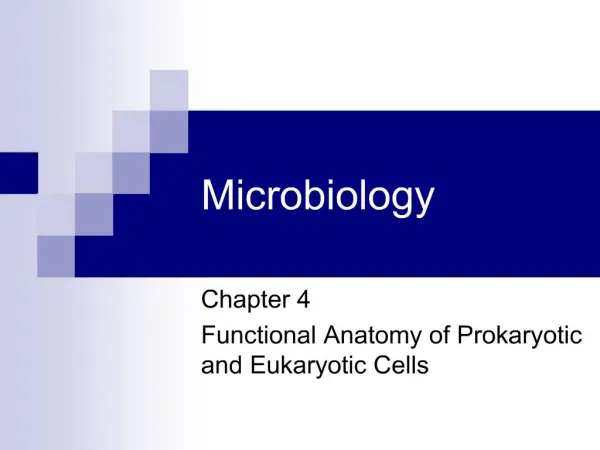
Distinguishing Prokaryotes and Eukaryotes: Key Characteristics and Differences
DESCRIPTION
This overview highlights the fundamental characteristics that differentiate prokaryotes from eukaryotes in microbiology. Prokaryotes, such as bacteria, are defined by their lack of a nuclear membrane, possessing a single circular chromosome, and they typically reproduce through binary fission. Their cell walls are primarily composed of polysaccharide peptidoglycan. In contrast, eukaryotes have DNA enclosed within a nuclear membrane, and they contain membrane-bound organelles, making them more complex. Understanding these differences is crucial for biological sciences.
Download
1 / 73
Télécharger la présentation 
Distinguishing Prokaryotes and Eukaryotes: Key Characteristics and Differences
An Image/Link below is provided (as is) to download presentation
Download Policy: Content on the Website is provided to you AS IS for your information and personal use and may not be sold / licensed / shared on other websites without getting consent from its author.
Content is provided to you AS IS for your information and personal use only.
Download presentation by click this link.
While downloading, if for some reason you are not able to download a presentation, the publisher may have deleted the file from their server.
During download, if you can't get a presentation, the file might be deleted by the publisher.
E N D
Presentation Transcript


More Related