The Periodic Table
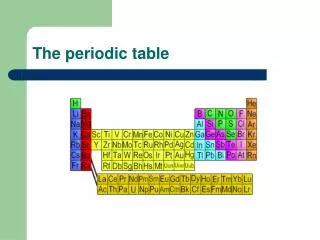
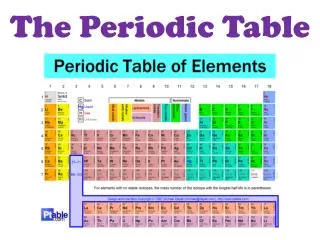
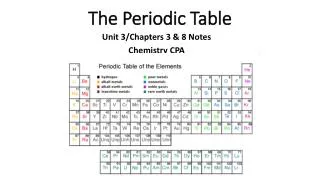
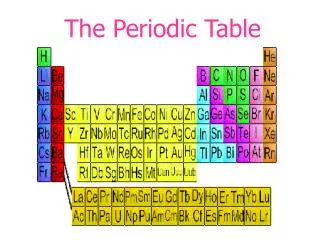
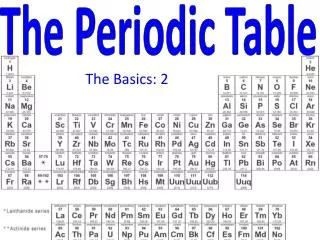
The periodic table is a systematic classification of chemical elements. From only 13 known elements in 1735 to over 100 today, it continues to evolve. Dmitri Mendeleev's 1886 model predicted missing elements. Elements are arranged by atomic number, reflecting the number of protons. The table provides atomic weight, symbol, and insights into element properties. Periods are the horizontal rows, and groups are the vertical columns, with elements in the same group exhibiting similar characteristics, such as the inert gases Helium, Neon, and others.

The Periodic Table
E N D
Presentation Transcript
The periodic table is a system which helps to classify the elements.
Today there are over 100 including several man-made elements.
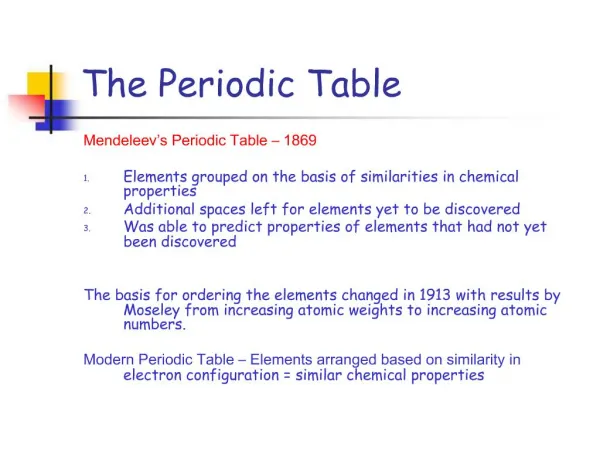
The periodic table that we use today was devised by a Russian scientist named Dmitri Mendeleev in 1886
Using his model, he was able to predict the properties of missing elements before their actual discovery took place.
The periodic table can tell us many things, elements are arranged in order of their atomic numbers.
The atomic number is based on the number of protons in the atom. A proton is a very small part of an atom that has a positive charge.
The atomic weight/mass of an element and symbol are also given.This is the average mass of the element based on atomic mass units (AMUs)
The atomic weight/mass of an element and symbol are also given
One AMU is equal to one twelfth (1/12) of the mass of carbon.
The horizontal rows in the periodic table are called periods.
All elements in the same group have similar characteristics. For example the last group – helium, neon, argon, krypton, xenon and radon are inactive gases