The New Imperialism: Beyond Congo
260 likes | 463 Vues
The New Imperialism: Beyond Congo. Origins and Terms. Some Qualifications. “New Imperialism” Focus on European imperialism Focus on imperialism in Africa and Asia. Two Explanations. Capitalism Increased productivity need for natural resources


The New Imperialism: Beyond Congo
E N D
Presentation Transcript
Some Qualifications • “New Imperialism” • Focus on European imperialism • Focus on imperialism in Africa and Asia
Two Explanations • Capitalism • Increased productivity need for natural resources • Increased need for natural resources increased competition among European countries • Increased productivity need for new markets • Marxism • History as struggle between haves and have-nots • Wealthy nations will use their strength to exploit weaker nations • Rich get richer at the expense of the poor • Independence movements will eventually challenge these power relationships
Terminology • Colony: a country/region governed internally by a foreign power (e.g. the Congo Free State under Leopold) • Protectorate: a country/region with its own government, which is controlled by a foreign power • Sphere of influence: an area where a foreign power claims exclusive trading privileges (e.g. Liberia and the US) • Economic imperialism: private business interests dominate less developed countries Increasing degree of control
Belgium • Congo, 1885-1962 • Rwanda-Urundi, 1916-1962 • Conquered from Germany during WWI • Coffee and labor • Tutsi “superiority”
France: Algeria • Invades 1830; rules 1962 • Large numbers of French settlers • Administered as a part of France, 1848-1962 • Increasing conflict between settlers (pieds-noirs) and native, indigenous Muslims • Algerian War, 1954-1962
France: Cote d’Ivoire • Before colonization, included several kingdoms • 1844: became a French protectorate • 1893: became a French colony • Coffee, cocoa, palm oil; significant French settlement
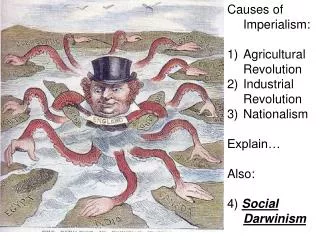
Great Britain • Attempt to establish a “red line from Cape to Cairo” – i.e., a continuous line of control from the northern to the southern end of Africa • Motives • Rivalries – especially with France • Economic development • Social Darwinism/“civilization” • The white man’s burden
Great Britain: South Africa • First settled by Dutch (Boers/Afrikaners) in the 1650s • Discovery of diamonds (1860s) and gold (1880s) • Second Boer War (1899-1902) gives Britain control • 1910: Union of South Africa more local control • 1931: Statute of Westminster effective independence • 1961: Creation of Republic of South Africa formal independence
Great Britain: Kenya • Protectorate from 1880s-1920; colony from 1920-1963 • White settlers farm coffee and tea • 1952-1959: Mau Mau rebellion – Kikuyu, extremely harsh detention system • 1963: independence and election of Jomo Kenyatta as president
Germany • Germany is unified in 1871 begins to develop a navy and look beyond Europe • Late arrivals to the “Scramble for Africa” • German East Africa (Rwanda, Burundi, Tanganyika) – 1885-1919 • German South West Africa (Namibia, parts of Botswana) – 1884-1915 • German West Africa (Cameroon, Togo) – 1884-1914 • Loses most colonial possessions after World War I
Two Exceptions • Ethiopia • Deceptive treaty with Menelik II, 1889 • Wins the First Italo-Ethiopian War, 1895-1896 • Liberia • Established by former American slaves, starting 1820 • Republic of Liberia established 1847 • Borders reduced by colonial competition with UK and France
China • Technically, never a colony (mostly) – but Europeans gain increasing power over trade • Opium trade with Britain; emperor forbids trade in 1838 • 1839-1842: First Opium War Treaty of Nanjing gives Britain rights and privileges in trade with China • France, Germany, and Russia also establish spheres of influence • Two actual colonies • Hong Kong: British colony, 1842-1941 and 1945-1997 • Macau: Portuguese colony, 1887-1999
India • Valued for tea, sugar, silk, salt, spices • Weakened by political and religious conflict • France and England fight over India • 1750s: British East India Company conquers Bengal (now Bangladesh) • British gradually expand control over India, Sri Lanka, Pakistan • Sepoy Rebellion (1857) leads Britain to take control from the British East India Company • Remains a British colony until 1947
French Indochina • Includes Vietnam, Cambodia, and Laos • First French presence: Catholic missionaries • Colony established 1887; Laos added in 1893 • Briefly supervised by Japan during WWII
Japan • Actually an imperial power • Isolation broken by Commodore Matthew Perry, 1853 Meiji Restoration, 1868-1912 • 1895: First Sino-Japanese War Japan colonizes Korea and Taiwan • 1904: Russo-Japanese War Japan colonizes Manchuria • Remains an imperial power until 1945
Economic • Modernization: infrastructure, technology, education, Western medicine • However, means of production remain in European hands • India: manufactured textiles raw cotton • Patterns of trade: dependence on Western manufactures and imports • Continued patterns of charity today?
Political • Maps are redrawn without regard for prior political or ethnic divisions • Iraq • Gambia • Ethnic rivalries • Site of European conflicts
Cultural • Spread of European languages • Religious influences • Decimation of African cultures, languages, traditions, systems of government… • European educational influences