
Discovering Genes and Chromosomes: Foundations of Genetics
E N D
Presentation Transcript
CHAPTER 10 The Nature of the Gene and the Genome
Introduction • Hereditary factors consist of DNA and reside on chromosomes. • The collective body of genetic information in an organism is called the genome.
10.1 The Concept of a Gene as a Unit of Inheritance (1) • Mendel’s work became the foundation for the science of genetics. • He established the laws of inheritance based on his studies of pea plants.
The Concept of a Gene as a Unit of Inheritance (2) • Characteristics of organisms are governed by units of inheritance called genes. • Each trait is controlled by two forms of a gene called alleles. • Alleles could be identical or nonidentical. • When alleles are nonidentical, the dominant allele masks the recessive allele.
The Concept of a Gene as a Unit of Inheritance (3) 2. A reproductive cell (gamete) contains one gene for each trait. a)Somatic cells arise by the union of male and female gametes. b) Two alleles controlling each trait are inherited; one from each parent. 3. The pairs of genes are separated (segregated) during gamete formation. 4. Genes controlling different traits segregate independently of each (independent assortment).
10.2 Chromosomes: The Physical Carriers of Genes (1) • The Discovery of Chromosomes • Chromosomes were first observed in dividing cells, using the light microscope. • Chromosomes are divided equally between the two daughter cells during cell division. • Chromosomes are doubled prior to cell division.
Chromosomes: The Physical Carriers of Genes (2) • Chromosomes as the Carriers of Genetic Information • Chromosomes are present as pairs of homologous chromosomes. • During meiosis, homologous chromosomes associate and form a bivalent; then separate into different cells. • Chromosomal behavior correlates with Mendel’s laws of inheritance.
Chromosomes: The Physical Carriers of Genes (3) • The chromosome as a linkage group • Genes that are on the same chromosome do not assort independently. • Genes on the same chromosome are part of the same linkage group. • The traits analyzed by Mendel occur on different chromosomes.
Chromosomes: The Physical Carriers of Genes (4) • Genetic Analysis in Drosophila • Morgan was the first to use fruit flies in genetic research. • Morgan only had available wild type flies but one he developed his first mutant, it became a primary tool for genetic research. • Mutation was recognized as a mechanism for variation in populations. • Studies with Drosophila confirmed that genes reside on chromosomes.
Chromosomes: The Physical Carriers of Genes (5) • Crossing Over and Recombination • Linkage between alleles on the same chromosome is incomplete. • Maternal and paternal chromosomes can exchange pieces during crossing over or genetic recombination.
Chromosomes: The Physical Carriers of Genes (6) • Crossing over and recombination • Percentage of recombination between a pair of genes is constant. • Percentage of recombination between different pairs of genes can be different. • The positions of genes along the chromosome (loci) can be mapped. • Frequency of recombination indicates distance, and increases as distance increases.
Chromosomes: The Physical Carriers of Genes (7) • Mutagenesis and Giant Chromosomes • Exposure to a sublethal dose of X-rays increases the rate of spontaneous mutations. • Cells from the salivary gland of Drosophila have giant polytene chromosomes. • Polytene chromosomes have been useful to observe specific bands correlated with individual genes. • “Puffs” in polytene chromosomes allow visualization of gene expression.
10.3 The Chemical Natureof the Gene (1) • DNA is the genetic material in all organisms. • The Structure of DNA: • The nucleotide is the building block of DNA. • It consists of a phosphate, a sugar, and either a pyrimidine or purine nitrogenous base. • There are two different pyrimidines: thymine (T) and cytosine (C). • There are two different purines: adenine (A) and guanine (G).
The Chemical Nature of the Gene (2) • Nucleotides have a polarized structure where the ends are called 5’ and 3’ . • Nucleotides are linked into nucleic acids polymers: • Sugar and phosphates are linked by 3’,5’-phosphodiester bonds. • Nitrogenous bases project out like stacked shelves.
The Chemical Nature of the Gene (3) • Chargaff established rules after doing base composition analysis: • Number of adenine = number of thymine • Number of cytosine = number of guanine • [A] + [T] ≠ [G] + [C]
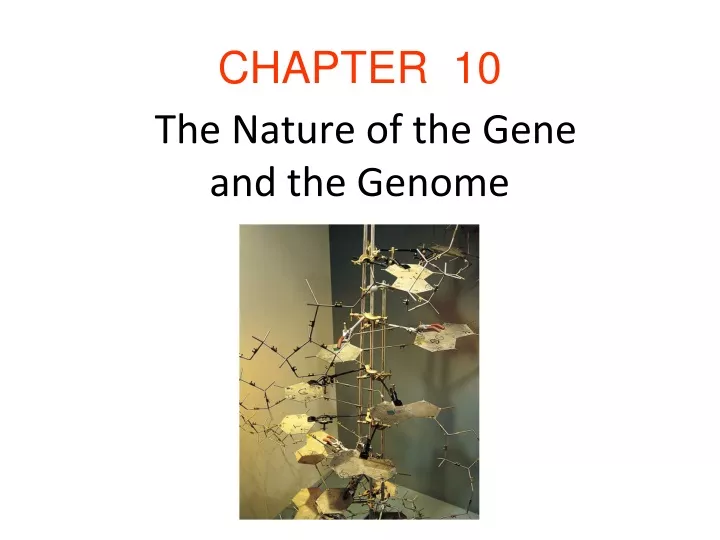
The Chemical Nature of the Gene (4) • The Watson-Crick Proposal • The DNA molecule is a double helix. • DNA is composed of two chains of nucleotides. • The two chains spiral around each other forming a pair of right-hand helices. • The two chains are antiparallel, they run in opposite directions. • The sugar-phosphate backbone is located on the outside of the molecule. • The bases are inside the helix.
The Chemical Nature of the Gene (5) • The Watson-Crick Proposal (continued) • The DNA is a double helix • The two DNA chains are held together by hydrogen bonds between each base. • The double helix is 2 nm wide. • Pyrimidines are always paired with purines. • Only A-T and C-G pairs fit within double helix. • Molecule has a major groove and a minor groove. • The double helix makes a turn every 10 residues. • The two chains are complementary to each other.
The Chemical Nature of the Gene (6) • The Importance of the Watson-Crick Proposal • Storage of genetic information. • Replication and inheritance. • Expression of the genetic message.
The Chemical Nature of the Gene (7) • DNA Supercoiling • DNA that is more compact than its relaxed counterpart is called supercoiled.
The Chemical Nature of the Gene (8) • DNA Supercoiling (continued) • Underwound DNA is negatively supercoiled, and overwound DNA is positively supercoiled. • Negative supercoiling plays a role in allowing chromosomes to fit within the cell nucleus.
The Chemical Nature of the Gene (9) • DNA Supercoiling (continued) • Enzymes called topoisomerases change the level of DNA supercoiling. • Cells contain a variety of topoisomerases. • Type I – change the supercoiled state by creating a transient break in one strand of the duplex. • Type II – make a transient break in both strands of the DNA duplex.
10.4 The Structure of the Genome (1) • The genome of a cell is its unique content of genetic information. • The Complexity of the Genome • One important property of DNA is its ability to separate into two strands (denaturation).
The Structure of the Genome (2) • DNA Renaturation • Renaturation or reanneling is when single-stranded DNA molecules are capable of reassociating. • Reanneling has led to the development of nucleic acid hybridization in which complementary strands of nucleic acids form different sources can form hybrid molecules.
The Structure of the Genome (3) • The Complexity of Viral and Bacterial Genomes • The rate of renaturation of DNA from bacteria and viruses depends on the size of their genome.
The Structure of the Genome (4) • The Complexity of the Eukaryotic Genome • Reanneling of eukaryotic genomes shows three classes of DNA: • Highly repeated • Moderately repeated • Nonrepeated
The Structure of the Genome (5) • Highly Repeated DNA Sequences – represent about 1-10% of total DNA. • Satellite DNAs – short sequences that tend to evolve very rapidly. • Minisatellite DNAs – unstable and tend to be variable in the population; form the basis of DNA fingerprinting. • Microsatellite DNAs – shortest sequences and typically found in small clusters; implicated in genetic disorders.
Fluorescence in situ hybridization and localization of satellite DNA
The Structure of the Genome (6) • Moderately Repeated DNA Sequences • Repeated DNA Sequences with Coding Functions – include genes that code for ribosomal RNA and histones. • Repeated DNA Sequences that Lack Coding Functions – do not include any type of gene product; can be grouped into two classes: SINEs or LINEs. • Nonrepeated DNA Sequences – code for the majority of proteins.
The Human Perspective: Diseases That Result from Expansion of Trinucleotide Repeats (1) • Mutations occur in genes containing a repeating unit of three nucleotides. • The mutant alleles are highly unstable and the number of repeating units tends to increase as the gene passes from parent to offspring. • Type I disease are all neurodegenerative disorders resulting form expansion of CAG trinucleotides.
The Human Perspective: Diseases That Result from Expansion of Trinucleotide Repeats (2) • Huntington’s disease (HD) result from ≥ 36 glutamine repeats in the huntingtin gene. • The molecular basis of HD remains unclear but it is presumed that expanded glutamine repeats are toxic to brain cell. • Type II diseases arise from a variety of trinucleotide repeats, and are present in parts of the gene that do not code for amino acids (i.e. fragile X syndrome).
10.5 The Stability of the Genome (1) • Whole Genome Duplication (Polyploidization) • Polyploidization (or whole genome duplication) occurs when offspring receive more than two sets of chromosomes from their parents. • Could be the result of hybrids from closely related parents. • Could result from duplicate chromosomes not separated in embryonic cells.
The Stability of the Genome (2) • Duplication and Modification of DNA Sequences • Gene duplication occurs within a portion of a single chromosome. • Duplication may occur by unequal crossing over between misaligned homologous chromosomes. • Duplication has played a major role in the evolution of multigene families.