Download
1 / 41
410 likes | 539 Vues
Meiosis is a crucial process in sexual reproduction that generates gametes—sperm and eggs—each carrying half the genetic material from each parent. This process introduces genetic variation through crossing over and independent assortment, paving the way for unique offspring. Unlike mitosis, meiosis consists of two rounds of division, resulting in four haploid cells. Homologous chromosomes pair up, leading to genetic recombination and diversity. Understanding meiosis allows us to appreciate the underlying mechanisms of heredity and trait inheritance in living organisms.

E N D
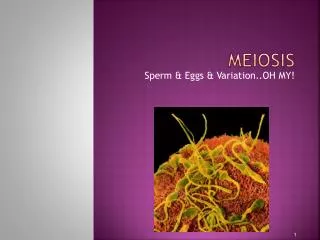
MEIOSIS Sperm & Eggs & Variation..OH MY!
Sexual Reproduction requires Cells Made by Meiosis • What if a new individual was formed through mitosis?
Genome • Genome: Complete complement of an organism’s DNA. • includes genes (control traits) and non-coding DNA organized in chromosomes
Genes • Eukaryotic DNA is organized in chromosomes • genes have specific places on chromosomes • exon: portion of a gene that is translated into protein (more in chapter 5) • intron: non-coding segment of DNA, often found within an exon; removed before transcription
Heredity • Heredity– way of transferring genetic information to offspring • Chromosome theory of heredity: chromosomes carry genes • Gene – “unit of heredity”
Sexual reproduction • Fusion of two gametes to produce a single zygote. • Introduces greater genetic variation, allows genetic recombination. • zygote has gametes from two different parents.
Chromosomes • Karyotype: • ordered display of an individual’s chromosomes • collection of chromosomes from mitotic cells • staining can reveal visible band patterns, gross anomalies • Make a Karyotype
HomologOUs CHROMOSOMES • Chromosomes exist in homologous pairs in diploid (2n) cells. • One chromosome of each homologous pair comes from the mother (called a maternal chromosome) and one comes from the father (paternal chromsosome). • Homologous chromosomes are similiar but not identical. Each carries the same genes in the same order, but the alleles (alternative form of a gene) for each trait may not be the same. • Exception: sex chromosomes (X, Y)
In humans … • 23 chromosomes donated by each parent (total = 46 or 23 pairs). • Gametes (sperm/ova): • contain 22 autosomes and 1 sex chromosome • haploid (haploid number “n” = 23 in humans) • Fertilization results in zygote with 2 sets of chromosomes - now diploid (2n). • Most cells in the body produced by mitosis. • Only gametes are produced by meiosis.
Chromosome numbers All are even numbers – diploid (2n) sets of homologous chromosomes.
Meiosis – key differences from mitosis • Meiosis reduces the number of chromosomes by half. • Daughter cells differ from parent, and each other. • Meiosis involves two divisions, Mitosis only one. • Meiosis I involves: • synapsis • homologous chromosomes pair up • chiasmataform (crossing over of non-sister chromatids) • metaphase I: homologous pairs line up at metaphase plate • anaphase I: sister chromatids do NOT separate • separation of homologous pairs of chromosomes, not sister chromatids of individual chromosome
Crossing over Chiasmata – sites of crossing over, occur in synapsis. Exchange of genetic material between non-sister chromatids. Crossing over produces recombinantchromosomes.
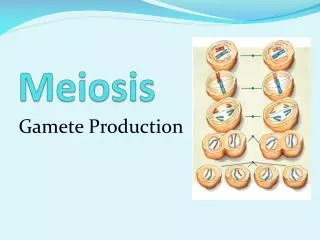
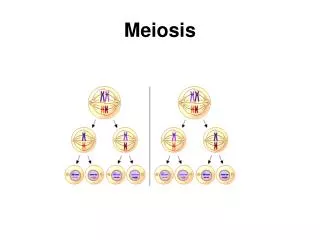
Meiosis I • Prophase 1 • each chromosome duplicates and remains closely associated (sister chromatids) • crossing-over can occur during the latter part of this stage • Metaphase 1 • homologous chromosomes align at the equatorial plate
Meiosis I • Anaphase 1 • homologous pairs separate with sister chromatids remaining together • Telophase 1 • two daughter cells are formed with each daughter containing only one chromosome of the homologous pair
Meiosis II Second division of meiosis: Gamete formation • Prophase 2 • DNA does not replicate • Metaphase 2 • chromosomes align at the equatorial plate
MEIOSIS II • Anaphase 2 • centromeres divide • sister chromatids migrate separately to each pole • Telophase 2 • cell division is complete • 4 haploid daughter cells
Meiosis creates genetic variation • During normal cell growth, mitosis produces daughter cells identical to parent cell (2n to 2n) • Meiosis results in genetic variation by shuffling of maternal and paternal chromosomes and crossing over • no daughter cells formed during meiosis are genetically identical to either mother or father • during sexual reproduction, fusion of the unique haploid gametes produces truly unique offspring
Independent assortment Number of combinations: 2n e.g. 2 chromosomes in haploid 2n = 4; n = 2 2n = 22 = 4 possible combinations
In humans e.g. 23 chromosomes in haploid 2n = 46; n = 23 2n = 223 = ~ 8 million possible combinations!
Crossing over Chiasmata – sites of crossing over, occur in synapsis. Exchange of genetic material between non-sister chromatids. Crossing over produces recombinantchromosomes.
HOW SEX IS DETERMINED IN HUMANS • Females don’t have a Y chromosome in any of their cells, yet they are able to develop and live normal, healthy lives. • For this reason, we know that nothing on the Y chromosome is absolutely necessary.
Random fertilization At least 8 million combinations from Mom, and another 8 million from Dad … >64 trillion combinations for a diploid zygote!!!
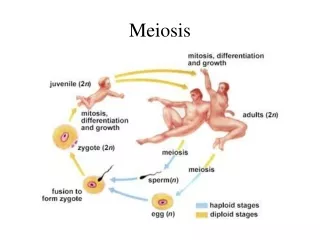
Meiosis & sexual life cycles • Life cycle = sequence of stages in organisms reproductive history; conception to reproduction • Somatic cells = any cell other than gametes, most of the cells in the body • Gametes produced by meiosis
Meiosis & sexual life cycles Generalized animal life cycle
Sex is costly! • Large amounts of energy required to find a mate and do the mating: specialized structures and behavior required • Intimate contact provides route for infection by parasites (AIDS, syphillis, etc.) • Genetic costs: in sex, we pass on only half of genes to offspring. • Males are an expensive luxury- in most species they contribute little to rearing offspring.
But … • More genetic diversity: more potential for survival of species when environmental conditions change. • shuffling of genes in meiosis • crossing-over in meiosis • fertilization: combines genes from 2 separate individuals
NONDISJUNCTION Unequal distribution of chromosomes during meiosis Resulting gametes zero or two copies of a chromosome instead of a single copy