
The Connection Between Emotional Language and Physiological Arousal: Insights from Semantic Processing
E N D
Presentation Transcript
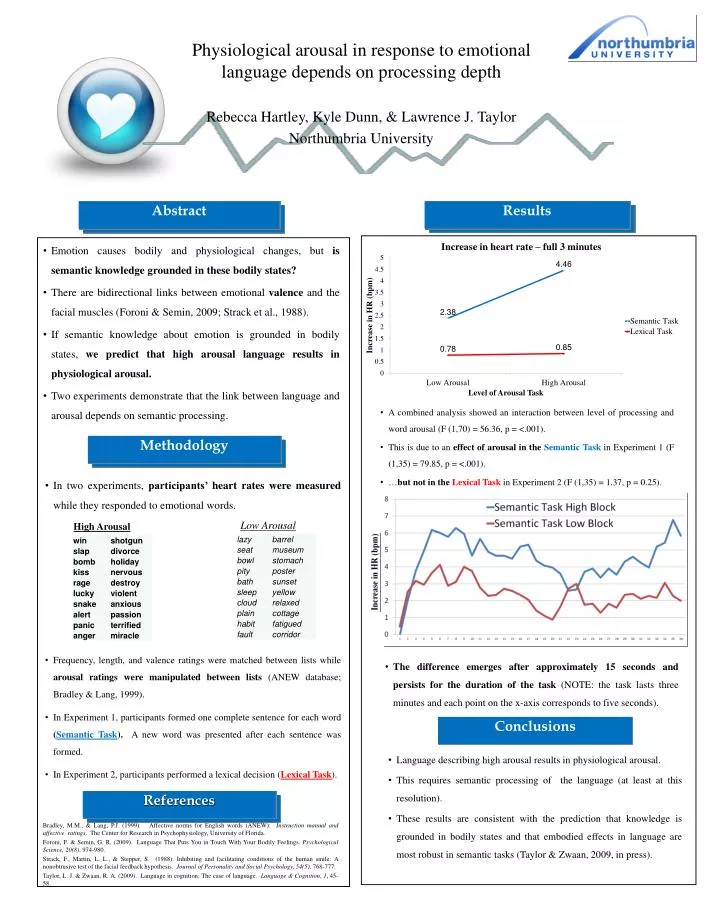
Results Abstract Methodology References Physiological arousal in response to emotional language depends on processing depth Rebecca Hartley, Kyle Dunn, & Lawrence J. Taylor Northumbria University • Emotion causes bodily and physiological changes, but is semantic knowledge grounded in these bodily states? • There are bidirectional links between emotional valence and the facial muscles (Foroni & Semin, 2009; Strack et al., 1988). • If semantic knowledge about emotion is grounded in bodily states, we predict that high arousal language results in physiological arousal. • Two experiments demonstrate that the link between language and arousal depends on semantic processing. • A combined analysis showed an interaction between level of processing and word arousal (F (1,70) = 56.36, p = <.001). • This is due to an effect of arousal in the Semantic Task in Experiment 1 (F (1,35) = 79.85, p = <.001). • …but not in the Lexical Task in Experiment 2 (F (1,35) = 1.37, p = 0.25). • In two experiments, participants’ heart rates were measured while they responded to emotional words. • Frequency, length, and valence ratings were matched between lists while arousal ratings were manipulated between lists (ANEW database; Bradley & Lang, 1999). • In Experiment 1, participants formed one complete sentence for each word (Semantic Task). A new word was presented after each sentence was formed. • In Experiment 2, participants performed a lexical decision (Lexical Task). Low Arousal High Arousal • The difference emerges after approximately 15 seconds and persists for the duration of the task (NOTE: the task lasts three minutes and each point on the x-axis corresponds to five seconds). Conclusions • Language describing high arousal results in physiological arousal. • This requires semantic processing of the language (at least at this resolution). • These results are consistent with the prediction that knowledge is grounded in bodily states and that embodied effects in language are most robust in semantic tasks (Taylor & Zwaan, 2009, in press). Bradley, M.M., & Lang, P.J. (1999). Affective norms for English words (ANEW): Instruction manual and affective ratings. The Center for Research in Psychophysiology, University of Florida. Foroni, F. & Semin, G. R. (2009). Language That Puts You in Touch With Your Bodily Feelings. Psychological Science,20(8),974-980. Strack, F., Martin, L. L., & Stepper, S. (1988). Inhibiting and facilitating conditions of the human smile: A nonobtrusive test of the facial feedback hypothesis. Journal of Personality and Social Psychology, 54(5), 768-777. Taylor, L. J. & Zwaan, R. A. (2009). Language in cognition: The case of language. Language & Cognition, 1, 45-58.