
Electric Fields
E N D
Presentation Transcript
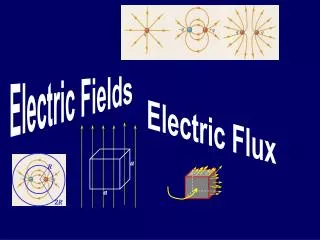
Electric Fields • Review Coulomb’s Law • Electric Fields • Multiple-charge Electric Fields • Continuous-charge Electric Fields • Parallel Plate Fields • Parallel Plate Examples • Gauss’s Law
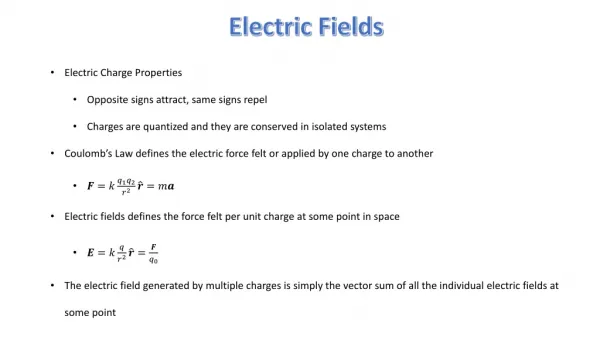
Coulomb’s Law • Fundamental property charge • Positive and negative charge • Units Coulombs (C) • Force Law
Compare with gravitation • Fundamental property mass • Positive mass only • Units kilograms (kg) • Force Law
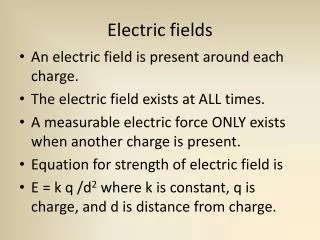
The “field” concept • Break problem into 2 parts: • Largest masses/charges create “field” • Smaller charges react with that field
“Field” concept for gravity • Newton’s Universal Law of Gravitation • One-step process (tedious) • Two-step process (simple)
“Field” concept for electrostatic • Cellphone Tower • Multiple users sharing same tower. • Why calculate each tower/phone combination separately? • 2 step process • 1. Tower creates common “field”. • 2. Calculate each phone’s interaction with that “field”. • “Field” is # of “bars” you have! • Only difference is “field” varies more with r
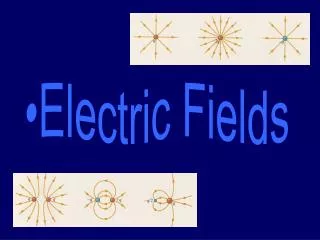
Electrostatic vs. Gravitational Field • In gravitation we calculate • Bracket part becomes “g” • In electrostatic we calculate • Bracket part becomes “E” • Field line point away from (+), toward (-) • F=qE (+) moves with field, (-) moves against field
Electric Field Animation • 2-D animation https://ef55311d-a-62cb3a1a-s-sites.googlegroups.com/site/physicsflash/Efield.swf?attachauth=ANoY7crCoduqPW1yrSvMtvv2qNVfA62NqyoNF1X8FY1ldipscty_-KXPmxmMyKYNdrruNd8vROoqOCxqee-i4LdS8Ct27vHfViZ597w8ETuqbnejUPkP7AiKqr4M-S3qn2VLzO2dQNl_KXv-Re0jQ5puGFnzKrPwZvuy0UkMwMU4QhXhJIIX4jWlWsQhQdgzqz-f17N3xQOXvEvfeWC1O-3ObHX89WV72w%3D%3D&attredirects=1
Electrostatic Field and Force Direction • Define: Field of +q1 points outward, -q1 points inward • Force on q2 (magnitude & direction) given by • Result: +q2 feels force with field, -q2 feels force against field • So like charges repel, opposite charges attract - +
What if gravity was attractive/repulsive??? • Positive and negative mass (!!) • (don’t worry, there isn’t such a thing) “Negative” mass falls to ceiling “Positive” mass falls to floor g
Electric Field - Example 16-8 (1) • Field from Q1 • Field from Q2
Electric Field - Example 16-8 (2) • Force on proton at P • Acceleration of proton at P • Force on electron at P • Acceleration of electron at P
Electric Field - Example 16-9 (1) • Get magnitudes
Electric Field - Example 16-9 (2) • XY table
Continuous charge distributions • Coulomb’s Law plus a lot of integral calculus! (don’t worry, I’ll just show results) • Field of line of charge • Field of ring of charge • Field of sheet of charge • Field between 2 sheets of charge
Summary- Continuous Charge Distributions • Coulomb’s Law + Lots of integral calculus = Other field variations • Example - sheets of charge (We just show results)
4 – Field between 2 Sheets of Charge • In region between parallel plates Note: now the field is constant • Coulomb’s Law + Lots of integral calculus = Constant fields (and we just show results)
4 - Field between 2 Sheets of Charge • In region between parallel plates • Note field is constant between plates • Uses for parallel plates • Capacitors (charge storage) • Beam accelerators / deflectors (old TVs, high-energy labs) • Semiconductor junctions • Photocopy machines
Example - Photocopy Field • Example 16-6 • Electrostatic for twice weight
Examples • Problem 23 • Problem 24
Examples • Problem 27 • Problem 31
Field Lines • Field lines start at (+) charge, end at (-) charge. Without charge, field lines don’t exist. • A (+) test charge moves in the direction of the field lines, a (-) test charge moves opposite the direction of field lines. • The cross-sectional density of field lines is proportional to the electric field strength.
Gauss’s Law • Number of field lines entering or leaving any volume proportional to charge enclosed. • Evaluate over entire closed surface • Field lines perpendicular to surface • Need to know symmetry
Gauss’s Law Examples • Point charge • Line of charge • Sheet of charge
Gauss’s Law 1 – Point charge • Point charge • For spherical surface
Gauss’s Law 2 – Line charge • Line charge • For cylindrical surface
Gauss’s Law 3 – Sheet charge • Sheet charge • For pillbox surface
Spring Break Assignment • Go skiing/Snowboarding • Take a spring mountain hike. • Walk around a hilly neighborhood. Slope electric field Elevation-> electric potential
Elevation vs Slope – Ski Map http://www.skitaos.org/Taos, NM
Elevation vs. Slope – contour lines Note contour lines If you know contour lines and spacing, you can calculate slope!!