SlideServe
Menu
Préférences
© SlideServe · v2026

Antarctic Neutrino Detector Deployment Plan 2005-2006

nasnan avatar
8 diapositives · 174 Views · Sep 23, 2014

This comprehensive plan outlines the goals for the deployment of a neutrino detector in Antarctica, including structural integrity verification, noise measurement, RF reflection study, and simulations tuning. It also discusses the proposal submission to NSF for additional drilling and the unique opportunities presented by acoustic measurements. The plan aims to set the groundwork for a full-scale deployment in the following year.
Antarctic Neutrino Detector Deployment Plan 2005-2006 - slide 1
01 / 8Antarctic Neutrino Detector Deployment Plan 2005-2006
1 / 17

Télécharger la présentation

Antarctic Neutrino Detector Deployment Plan 2005-2006
Une image / un lien ci-dessous est fourni (tel quel) pour télécharger la présentation

Politique de téléchargement : le contenu du site vous est fourni TEL QUEL pour votre information et votre usage personnel ; il ne peut être vendu, concédé sous licence ni partagé sur d’autres sites sans l’accord de son auteur.Le contenu vous est fourni TEL QUEL, pour votre information et votre usage personnel uniquement. Téléchargez la présentation en cliquant sur ce lien. Lors du téléchargement, si vous ne parvenez pas à télécharger une présentation, l’éditeur a peut-être supprimé le fichier de son serveur.Pendant le téléchargement, si vous ne parvenez pas à obtenir une présentation, le fichier a peut-être été supprimé par l’éditeur.

F I N

Plus de contenu associé

Transcription de la présentation
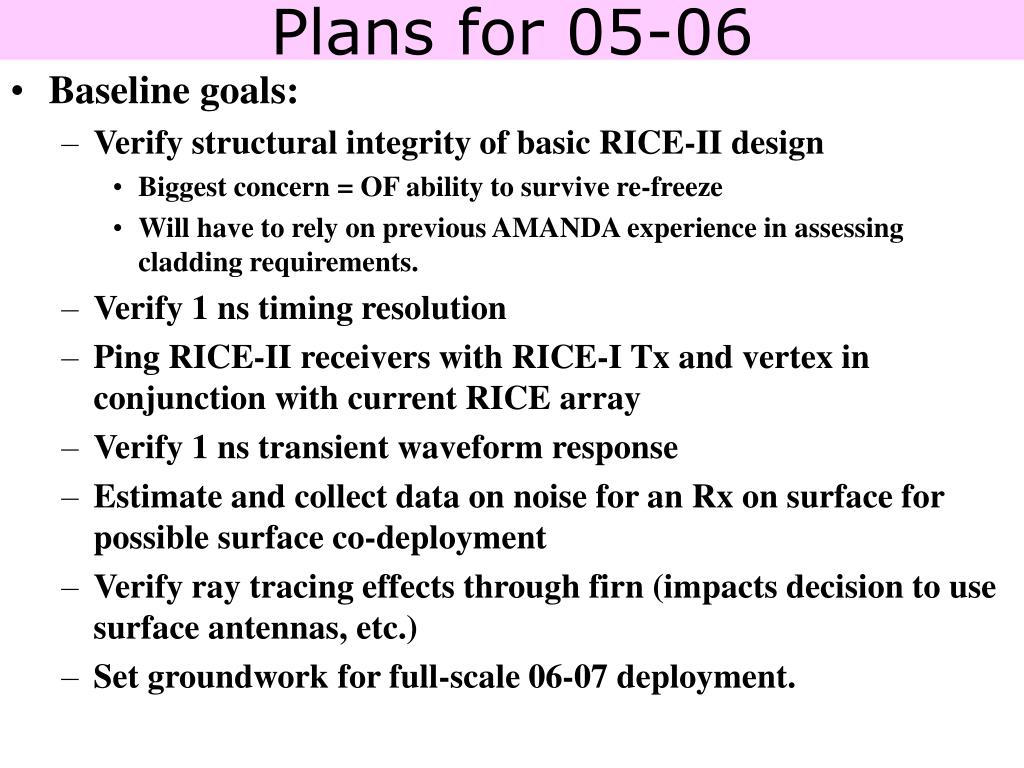
  1. Plans for 05-06 • Baseline goals: • Verify structural integrity of basic RICE-II design • Biggest concern = OF ability to survive re-freeze • Will have to rely on previous AMANDA experience in assessing cladding requirements. • Verify 1 ns timing resolution • Ping RICE-II receivers with RICE-I Tx and vertex in conjunction with current RICE array • Verify 1 ns transient waveform response • Estimate and collect data on noise for an Rx on surface for possible surface co-deployment • Verify ray tracing effects through firn (impacts decision to use surface antennas, etc.) • Set groundwork for full-scale 06-07 deployment.

  2. 2005-06 plan, cont. • With existing, or to-be-drilled dry holes, measure noise @surface & examine surface waves beyond TIR. • Re-do RF reflection off bed; investigate coupling to snow, position-dependence of R(bottom), etc. • If access into IceCube holes possible: • Determine robustness of OF to freeze-in: • Drop ~300 m length of well-clad OF into IceCube hole (no attached electronics). OTDR during freeze-in; evaluate loss of signal • Radioglaciology/coupling of horn to firn: • Transmission thru firn: Drop aluminum reflector, on rope, into IC hole to depth of ~250 m. Ping with RF transmitter; look at reflected signal. • Submitting proposal to NSF for additional hole drilling

  3. Comment on drilling/geometry • Co-deployment in IC holes~1/3 Veff at high end relative to “ideal” geometry, but lower threshold relative to sparse array • Simulations tuning on ESS events: • dz~dQc at R~latten (R=distance to neutrino vertex) • ~100-120 m vertical spacing b/w Rx • dr ~latten/2 • ~500 m - 1 km horizontal spacing b/w Rx

  4. ICP geometry vs. 1 km-spacing

  5. ICP vs. 1km-hole spacing Veff 3x Veff at high end, but flux~E-3

  6. General comment on schedule • As attention increasingly focuses on GZK end of neutrino spectrum, increasing likelihood that GZK-expt will be built • ANITA, SalSA, OWL, etc (Rolf talk)… • Aside: have run salt vs. ice sims (ICRC05): • Salt signal~1/3 ice-signal, but higher density compensates in overall event rate • ANTARES+acoustic & IceCube+acoustic/radio are unique opportunities for a detector with sensitivity in range 102 GeV1011 GeV.

  7. Goals of NSF proposal • 3 dry holes, to depth of 300m @Pole, at r=0, r=2/3 km, r=2 km • Transparency measurements, horizontally, as f(z) • Birefringence measurements require <1ns timing at receiver. • Utility for acoustic measurements?