Key Events Leading to American Independence (1763-1783)
This review outlines critical events in the lead-up to the American Revolution from 1763 to 1783. It highlights major legislative acts imposed by Britain, including the Proclamation of 1763, Sugar Act, Stamp Act, and Quartering Act, which incited colonial discontent. Events like the Boston Massacre, Boston Tea Party, and the First Continental Congress illustrate growing tensions. Thomas Paine's "Common Sense" and the Declaration of Independence mark pivotal moments in the struggle for autonomy, culminating in the British surrender at Yorktown and the Treaty of Paris that recognized U.S. independence.


Key Events Leading to American Independence (1763-1783)
E N D
Presentation Transcript
American Revolution Unit 2 Review
Proclamation of 1763 • Britain wanted to make peace with Indians and avoid further conflict on the frontier.
Sugar Act 1764 • Increased tax on foreign imported sugar from the West Indies.
Stamp Act, 1765 • England was broke from the French and Indian War. Needed to raise money. • Heavily enforced the Navigation Laws. • Stamp Act 1765, raised taxes: 1. Commercial and legal documents 2. Playing cards 3. Newspapers 4. Marriage licenses
Quartering Act 1765 • Required certain colonies to provide food and quarters for British troops.
“No Taxation Without Representation” • Argument that the colonist needed representation in the British government.
First Continental Congress 1774 • 12 out of the 13 colonies joined in Philadelphia, PA. • There to discuss Intolerable Acts • Called for complete boycott of British goods. Began forming militias (minutemen). • Not calling for independence.
Lexington & Concord • April 1775 • British soldiers moved to Lexington to seize colonists’ arsenal of weapons. • Battle ensues and 300 dead.
Tensions are high….I Think • 2nd Continental Congress met in Philadelphia. All 13 colonies are represented. • No fight for independence, they just wanted to continue fighting in the hope that King George III & Parliament would correct problems. • George Washington selected to lead: Army background.
Intentions unclear the first year of the war. • July 1775: Continental Congress: Olive Branch Petition- professing American loyalty to the Crown, begging the King to prevent hostilities. • August 1775: King George III decides “No Reconciliation.” 1. Colonies are rebelling. 2. Hired Hessians “German Soldiers” to fight the rebels.
Thomas Paine • Why do Americans continue to deny independence? • Loyalty to empire deeply ingrained • Poor unity among colonies • “Common Sense” - pamphlet • 120,000 copies sold • “Royal Brute of Great Britain” • Rights of man • Power flowed from the people
Declaration of Independence • July 4, 1776, Thomas Jefferson • Justification of rebellion lies in the idea of natural rights. • http://www.youtube.com/watch?v=C7o5kWrbJJE • http://www.youtube.com/watch?v=IoLlrrkCZSU
British kicked out of Boston, set up fort in NY. 1776, Battle of Trenton: Washington surprises and captures thousands of Hessians.
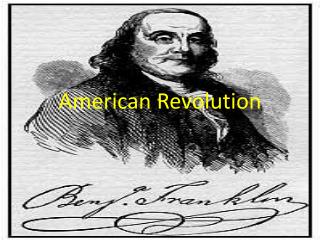
France seeks revenge on Britain • 1778, Ben Franklin secures a Treaty of Alliance with France • Spain & Holland followed, conflict turns global • 1778-1783: France supplies America with weapons, money, equipment, ½ of all armed forces, and virtually all naval power
Yorktown, 1781 • French help Americans lead an assault while British are waiting for reinforcements and supplies • British surrender 7,000 troops • British begin growing tired of the fight
Treaty of Paris 1783 • Britain formally recognized the independence of the United States.
Clips • http://www.youtube.com/watch?v=2YHl_0P2EJ4