Comparative Study of Spin-Dependent Total Cross Sections in Antiproton-Proton and Proton-Proton Interactions
This study presents a comprehensive analysis of spin-dependent total cross sections in both antiproton-proton and proton-proton interactions, utilizing data from the PAX experiment at the FAIR facility. We explore the reaction matrix and measure longitudinal and transverse cross-section differences (ΔσL and ΔσT) through advanced methods and detectors. Key findings include refinements to existing theoretical models and experimental observations that enhance understanding of quantum interactions at energies ranging from 1.5 to 15 GeV/c.

Comparative Study of Spin-Dependent Total Cross Sections in Antiproton-Proton and Proton-Proton Interactions
E N D
Presentation Transcript
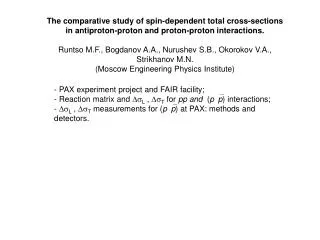
The comparative study of spin-dependent total cross-sections in antiproton-proton and proton-proton interactions. Runtso M.F., Bogdanov A.A., Nurushev S.B., Okorokov V.A., Strikhanov M.N. (Moscow Engineering Physics Institute) • PAX experiment project and FAIR facility; • Reaction matrix and L , T for pp and (pp) interactions; • L , T measurements for (pp) at PAX: methods and detectors.
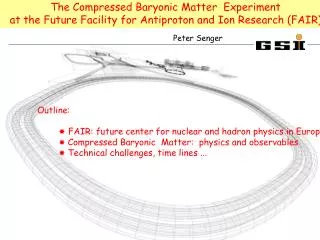
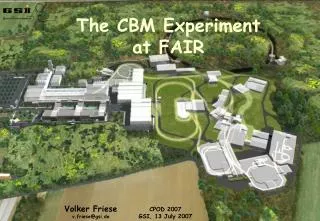
Fig. 1. FAIR facility. FAIR – Facility for Antiproton and Ion Research, APR – Antiproton Polarizer, CSR – Cooler Synchrotron Ring, HESR – High Energy Storage Ring, PAX - Polarised Antiproton Experiment . 1.5 – 15 GeV/c - Fixed Target Mode, (1.5 – 15) GeV/c x 3.5 GeV/c – Collider Mode.
Reaction matrix. - reaction matrix definition (1) Independent amplitudes (from generalized Pauli principle and parity Conservation in the strong interaction) + and - - helicities in c.m. [1] M. Jacob and G.C. Wick, Ann. Phys. (N.Y.), 7 (1959) 404. From helicity conservation 4(0)=0=5(0). From generalized optical theorem [2,3]. (2) Real parts can be found throw dispersion relations.
[5] E.A. Andreeva et al., Int. J. Mod. Phys., A13 (1998) 1515-1522. (3) [2] S.M. Bilenky and R.M. Ryndin, Phys. Lett. 6 (1963) 217; [3] R.T.N. Phillips, Nuclear Physics, 43 (1963) 413; (4) Total spin dependent contribution 1 and spin projection dependent contribution 2 can be got from 3 observables: 0 with unpolarized beam and target; T = 21 with transversally polarized beam and target; L = 2(1+2) with longitudinally polarized beam and target (transverse and longitudinal total cross-section differencies). (5)
Fig. 3. Previous measurements of L(pp) PAX energies [4] D. P. Grosnick et al., Physical Review D, 55, 3 (1997) 1159 – 1187. E704 (200 Gev/c): L(pp) (b)= 42 48 (stat) 53 (sist), L(pp) (b) = - 256 124 (stat) 109 (sist) .
Fig. 4. s-dependence of total cross-section p-p and antip-p interaction in PAX energy range. Particle data (2004): tot(pp) = 35.48 + 0.31 ln2(s/30.25) + 41.35 (1/s)0,417 – 31.04 (1/s)0,547 tot(pp) = 35.45 + 0.308 ln2(s/28.94) + 42.53 (1/s)0,458 – 33.34 (1/s)0,545 (6)
Fig. 5. T(plab). Fig. 6. -L(plab) Solid line - =0.079, dashed line - =0, dotted line – Regge pole model. . [4], [6] W. de Boer et al., Phys. Rev. Lett. 34 (1975) 558. [7] I.P. Auer et al., Phys. Lett., 67B (1977) 113; Phys. Rev. Lett. 41 (1978) 354. [8] I.P. Auer et al., Phys. Lett., 70B (1977) 475; Phys. Rev. D. 34 (1986) 2581; Phys. Rev. Lett., 62 (1989) 2649.
[9] S.A Dunne, Phys. Rev. Lett. 19 (1967) 1299. Asimptotic relation , derived from the Regge model with cuts. (7) putting n=3 (number of exchanged reggeons). 3(0) - 1 = 3 , where is an excess of pomeron intercept over 1 at t=0, one can gets the final expression for the fit of experimental data: [10] L.I. Lapidus, Proc. of the XI LINP Winter Scool, 1976, p. 55. (8) For high energies (tot rises) tot= 22,0 s 0,079+ 56,1 s-0,46 (9) [11] Review of particle Physics, Phys. Rev., 54D (1996) 191. For low energies only one exchanged Reggeon is supposed, so =0.
E704 Fig. 7. |L|(s) for pp interaction. From fit to experiments [5] 31=-2 and from (5) L=-2T
With the PAX detector the transverse cross section difference T, as it was declared in PAX proposal, can be accessed by two methods [12] (1) from the rate of polarization buildup for a transversely polarized target when only a single hyperfine state is used; (2) from the difference in beam lifetime for a target polarization parallel or antiparallel to the beam. An accuracy at the 10-4 level has been achieved by the TRIC experiment at COSY using this method. [12] Technical proposal for Antiproton-Proton Scattering Experiments with polarization (PAX collaboration), Julich, 2005.
Total cross-section from elastic differential cross-section Fig. 8. The |t| dependence of the elastic pp differential cross-section. Region I – a pure Coulomb scattering, II – Coulomb – Nuclear Interference region, III – nuclear (diffraction) scattering region.
[13] A.A. Bogdanov et al., Jadernaja Fizika (rus.), 66 (2003), N 12, 1-11. • - the fine structure constant and F(t) - the proton electromagnetic form factor. where
Peculiar points for del/dt(|t|) Detector dimentions Fixed target mode
Collider mode p11=p22 elastic scattering conditionfor antisimmetric collider. Detector dimentions
[14] P. Kroll, W. Shweiger, Nuclear Physics, A503 (1989) 865-884. Fig. 9. The pp parameter vs plab.
The Indirect method of the measurement of total cross section. The best precision by this method, 0.5 – 1 %, was achieved at ISR.
Detector dimentions Fixed target mode t=0.01 p= 1.5 GeV/c R10m=66.8 cm p= 15 GeV/c R10m=6.7 cm t=0.1 p= 1.5 GeV/c R10m=213 cm p= 15 GeV/c R10m=21 cm Collider mode t=0.01 p= 12.3 GeV/c R10m=8.1 cm p= 114 GeV/c R10m=1.6 cm t=0.1 p= 12.3 GeV/c R10m=25.5 cm p= 114 GeV/c R10m=5.0 cm
Fig.10. Possible constructions of silicon strip detector (a) and scintillation detectors for PAX total cross-section measurements.
Summary. The interest in the spin dependent total cross-sections measurements at PAX energy range is justified by the following reasons: - at any energy one needs to reconstruct the imaginary parts of elastic scattering amplitudes 1, 2 and 3; - at high energy we hope to reveal the spin contributions to the total cross-sections by separating the singlet and triplet states; - several schemes of the spin-dependent total cross-sections measurement are discussed.