
SlideServe
Menu
Préférences
© SlideServe · v2026

Knowledge Transfer Partnerships (KTPs)

neylan avatar
11 diapositives · 365 Views · Aug 04, 2014

Knowledge Transfer Partnerships (KTPs). Technology Readiness Level (TRL ). 1. 2. 3. 4. 5. 6. 7. 8. 9. Where is KTP on the innovation spectrum? . Research. Design/Develop. Develop/Produce. Product prepared for manufacture. Idea developed. Prototype/ demo developed.
Knowledge Transfer Partnerships (KTPs) - slide 1
01 / 11Knowledge Transfer Partnerships (KTPs)
1 / 17

Télécharger la présentation

Knowledge Transfer Partnerships (KTPs)
Une image / un lien ci-dessous est fourni (tel quel) pour télécharger la présentation

Politique de téléchargement : le contenu du site vous est fourni TEL QUEL pour votre information et votre usage personnel ; il ne peut être vendu, concédé sous licence ni partagé sur d’autres sites sans l’accord de son auteur.Le contenu vous est fourni TEL QUEL, pour votre information et votre usage personnel uniquement. Téléchargez la présentation en cliquant sur ce lien. Lors du téléchargement, si vous ne parvenez pas à télécharger une présentation, l’éditeur a peut-être supprimé le fichier de son serveur.Pendant le téléchargement, si vous ne parvenez pas à obtenir une présentation, le fichier a peut-être été supprimé par l’éditeur.

F I N

Plus de contenu associé

Transcription de la présentation
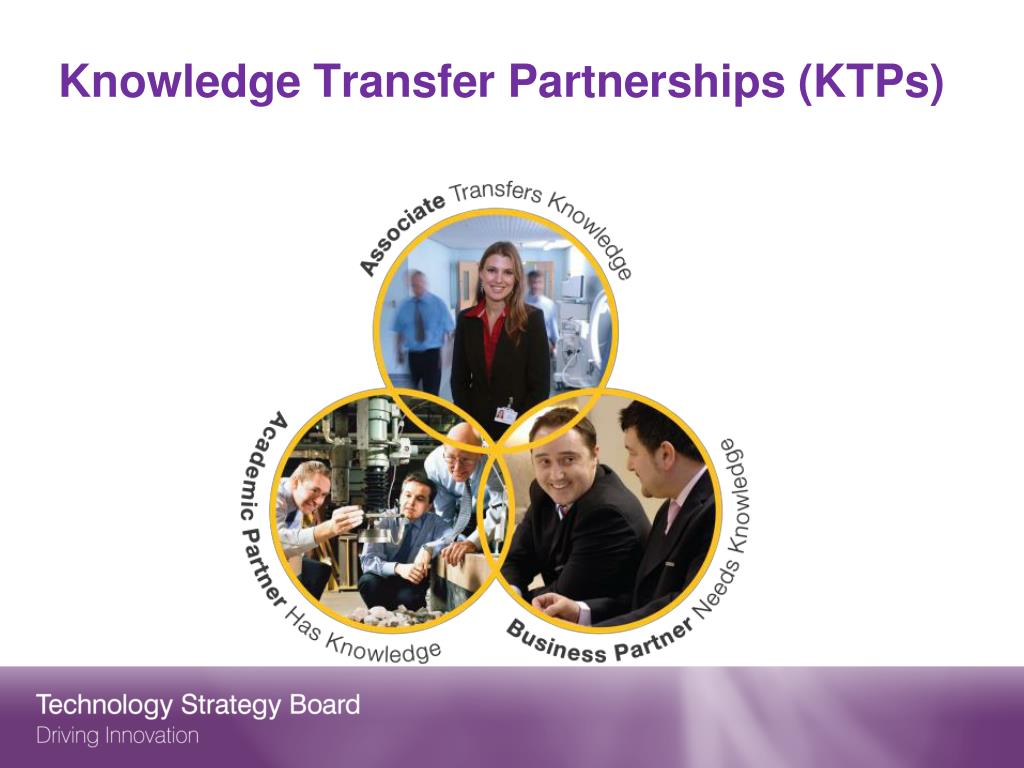
  1. Knowledge Transfer Partnerships (KTPs)

  2. Technology Readiness Level (TRL) 1 2 3 4 5 6 7 8 9 Where is KTP on the innovation spectrum? Research Design/Develop Develop/Produce Product prepared for manufacture Idea developed Prototype/ demo developed Product & associated processes mature Idea concrete; application determined Demonstrator performs Product Development KTP

  3. KTP - main points • Partnership between business and academia - must be driven by business need • Annual project budget of ~£65k • Typically 67% grant funding for SME and 50% for large company • Project length typically 2 years • 90% success rate for proposals • Pre-proposal checks and process supported by network of 24 Regional KTP Advisers

  4. KTP benefits • For every £1m of government money invested: • 32 new jobs were created • 269 company staff were trained • £0.84m was invested on average by companies in plant and machinery • £1.15m was invested on average by companies in R&D • businesses predicted a post-project increase in annual pre-tax profit of £3.46m. Source: Knowledge Transfer Partnerships Achievements & Outcomes, 2012/13 Annual Report

  5. KTP thematic competitionAgrifood Supply Chain Information provided by: John Whittall Lead Technologist, Sustainable Agriculture & Food Nick Bassett Lead Technologist Biosciences

  6. Agri-food supply chain • Contributes £96 billion or 7% of UK GVA • Sector challenges include • Global food security • Resilience to environmental stresses • Rise in chronic, diet-related health conditions • Food safety, authenticity and traceability • Increased engagement with TSB over last 5 years • AgriTech strategy, SAF IP & Biosciences programmes • ~50 KTPs formally classified as Agriculture or Food since 2007

  7. Competition features • Competition budget £2.3m including co-funding • Competition opens 19 June • Competition close Feb 2015 • Typical 2 yr duration for KTPs in this call - longer possible if justified • Previous involvement in KTPs (outside this call) not taken into account • Regional engagement events planned Sept / Oct 14 • Networking events and other activities planned to support “cohort” of KTP Associates funded through this call

  8. Co-funders • Across full scope of competition • On a project basis

  9. High level scope Spanning the Agri-food supply chain • Innovation for consumer health, wellbeing and choice • Improving productivity, resource efficiency and resilience in the supply chain • Assuring safety and security across the supply chain

  10. Illustrative project areas • Application of genetic and breeding approaches to crops and livestock • Food safety, authenticity and traceability • Improved methods to control yield/productivity loss or product quality deterioration • Improved resource efficiency and/or waste minimisation • Improving nutritional quality through better products or ingredients • Measurement, control and precision application technologies • Modern manufacturing methods • Packaging and logistics supply chain • Technologies, approaches or services which support the sustained modification of consumer or employee behaviours • Use of data • Use of systems-based approaches

  11. Thank you! e: trevorg@iatpuk.com m: 07711 850940 www.innovateuk.org