Enzymes
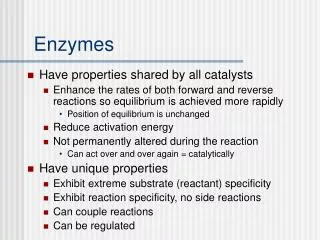
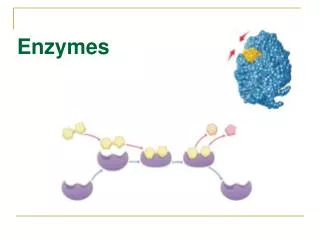
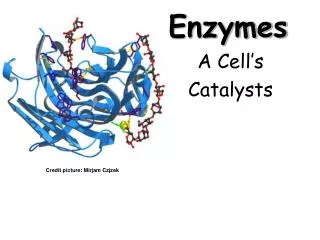
Enzymes are biological catalysts that facilitate chemical reactions by lowering the activation energy required. They act on specific reactants, called substrates, which bind to the enzyme's active site. This enzyme-substrate complex leads to the formation of products. However, enzymes can become denatured when changes in pH or temperature alter their shape, impacting their functionality. Understanding these concepts is essential for studying biochemical processes and how catalysts work to drive essential reactions in living organisms.


Enzymes
E N D
Presentation Transcript
Chemical reactions • Chemically change substances • Reactant – goes into the reaction • Product – goes out of the reaction
Enzymes • Activation energy is the energy needed to start a reaction • Catalysts are substances that “jump-start” a reaction • Biological catalysts are known as enzymes
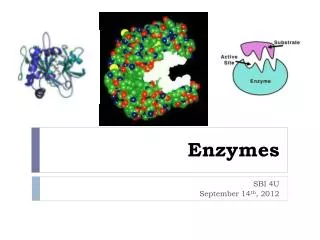
Enzymes • Are made of proteins • Has a site where the substrate can be brought together to react (called the active site) • Changes in pH and temperature can affect the shape of enzymes • A substrate is a reactant for enzymes
Denatured Enzymes • Enzymes are denatured when the active site changes shape due to changes in the pH or temperature