Advances in DNA Technology: The Human Genome Project and Genetic Engineering Techniques
The Human Genome Project (HGP) was a landmark international study that mapped roughly 25,000 genes and sequenced over 3 billion nitrogen bases in human DNA. This monumental endeavor has led to improved methods of DNA analysis and highlighted crucial ethical, legal, and social issues in genetics. Techniques such as Restriction Fragment Length Polymorphism (RFLP) and Polymerase Chain Reaction (PCR) have become vital in DNA profiling, disease locators, and genetic engineering, allowing for advancements in cloning, disease research, and the development of genetically modified organisms like Golden Rice and Arctic Apples.

Advances in DNA Technology: The Human Genome Project and Genetic Engineering Techniques
E N D
Presentation Transcript
HGP – Human Genome Project • International study to determine: • ~25,000 genes • Sequence of 3 billion nitrogen bases (A,T,C,G’s) • Create & improve methods of analyzing DNA • Address ethical, legal & social issues
RESTRICTION FRAGMENT LENGTH POLYMORPHISM (RFLP) • Technique used to isolate sections of DNA • 1st used in DNA profiling, also used in paternity tests, genome maps & disease locators. • DNA is broken up (restriction enzyme) & sorted by size using gel electrophoresis
RESTRICTION FRAGMENT LENGTH POLYMORPHISM • Results then transferred to membrane (Southern Blot) • DNA probes are then attached to each broken segment to determine actual nucleotide sequence
RFLP SNP’s • Issues: • Requires large #of DNA samples • Long, complicated process • Replaced RFLP for SNP Single Nucleotide Polymorphism • Most common form of genetic variation btw people • Occurs 1 in every 300 bases • 99% of genetic code is same.
POLYMERASE CHAIN REACTION (PCR) • Method used to produce millions of copies of a small sample of DNA in approx. 2 hours. • Denature DNA & force replication to occur. • Process is repeated thru multiple cycles to produce millions of copies.
POLYMERASE CHAIN REACTION (PCR) • Taq polymerase • Extracted from bacteria live in hot springs • Process: • Denaturing (break open) • Annealing (primers or synthetic DNA strands attach) • Extension (enzyme initiates replication)
STEM CELLS • Early embryonic cells that have yet to differentiate (specialize) • Cloning • Disease research & treatment • Creation of genetically modified products/organisms
GENETIC ENGINEERING • Manipulating genetic material • Genetic Modifications • Changes to an organism DNA • Transgenic Modifications • Combining DNA from 2 separate organisms • Cross-breeding • Unnatural breeding of organisms
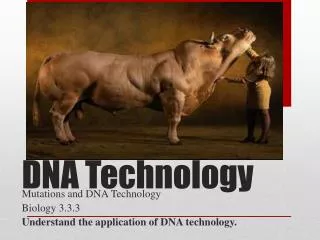
CROSS-BREEDING • Beefalo • Cross between domestic cattle & American buffalo • Buffalo are larger, heartier animals that require less care • Retain the flavor of beef • 3/8 bison • 5/8 bovine • Fertile offspring
GENETIC MODIFICATION • Arctic Apple • Turn off the gene that controls the enzyme polyphenoloxidase • Prevent browning of apples
TRANSGENIC MODIFICATIONS • Golden Rice • Splice genes from daffodils into the genome of white rice • Increase the vitamin A content of the rice