The Evolution of Ancient Indian Civilization: From the Indus Valley to the Gupta Empire
This overview explores the development of ancient Indian civilization from the Harappan period through the rise of the Maurya and Gupta Empires. It highlights the geographical and environmental factors influencing agriculture and culture, the impact of the Aryans, and the emergence of notable religious beliefs such as Hinduism and Buddhism. The role of trade along the Silk Road, the establishment of the caste system, and significant advancements during the Golden Age are also discussed, illustrating how social, political, and economic dynamics shaped the subcontinent's history.

The Evolution of Ancient Indian Civilization: From the Indus Valley to the Gupta Empire
E N D
Presentation Transcript
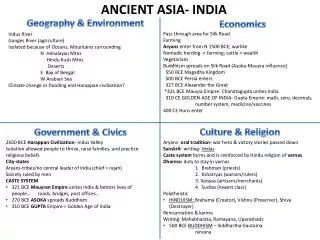
ANCIENT ASIA- INDIA Geography &Environment Economics Pass through area for Silk Road Farming Aryans enter from N 1500 BCE; warlike Nomadic herding -> farming; cattle = wealth Vegetarians Buddhism spreads on Silk Road (Asoka-Mauyra influence) 550 BCE Magadha Kingdom 500 BCE Persia enters 327 BCE Alexander the Great *321 BCE Mauyra Empire: Chandragupta unites India 310 CE GOLDEN AGE OF INDIA- Gupta Empire: math, zero, decimals, number system, medicine/vaccines 400 CE Huns enter Indus River Ganges River (agriculture) Isolated because of Oceans, Mountains surrounding N Himalayan Mtns Hindu Kush Mtns Deserts E Bay of Bengal W Arabian Sea Climate change or flooding end Harappan civilization? Culture & Religion Government & Civics • 2500 BCE Harappan Civilization- Indus Valley • Isolation allowed people to thrive, raise families, and practice religious beliefs • City-states • Aryans-tribes/no central leader of India (chief = rajah) • Society ruled by men • CASTE SYSTEM • 321 BCE Mauyran Empire unites India & betters lives of people… roads, bridges, post offices… • 270 BCE ASOKA spreads Buddhism • 310 BCE GUPTA Empire = Golden Age of India • Aryans- oral tradition- war hero & victory stories passed down • Sanskrit- writing: Vedas • Caste system forms and is reinforced by Hindu religion of varnas • Dharma: duty to stay in varnas • 1. Brahman (priests) • 2. Kshatryas (wariors/rulers) • 3. Vaisyas(artisans/merchants) • 4. Sudras (lowest class) • Polytheistic • HINDUISM: Brahama(Creator), Vishnu (Preserver), Shiva (Destroyer) • Reincarnation & karma • Writing: Mahabharata, Ramayana, Upanishads • 500 BCE BUDDHISM – Siddhartha Gautama • nirvana