Download
1 / 22
230 likes | 366 Vues
In this comprehensive overview, Dr. Gerlinde Mandersloot discusses the critical factors involved in optimizing organ donation from brain stem-dead donors. Special emphasis is placed on the physiological consequences of brain stem death, including complications like diabetes insipidus and hypovolaemia. The presentation outlines methods for patient stabilization during neurological examinations, the need for consistent donor management practices, and innovative strategies aimed at increasing organ viability and transplantation rates. Join Dr. Mandersloot to explore the intricacies of organ donation and the future of donor optimization.

E N D
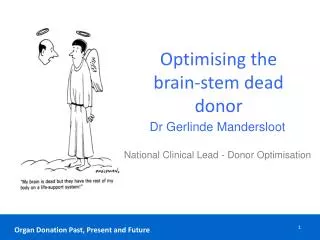
Optimising the brain-stem dead donor Dr Gerlinde Mandersloot National Clinical Lead - Donor Optimisation Dr Gerlinde Mandersloot 20th April 2012 1 Organ Donation Past, Present and Future
Challenges • Physiological consequences of BSD Organ Donation Past, Present and Future
‘Collateral damage’ • Hormonal • Diabetes insipidus • Hypovolaemia • Hypernatraemia • T3 / T4 reduces • ACTH • Blood glucose • Hypothermia 5 Organ Donation Past, Present and Future
Incidence of organ involvement • Hypotension 81% • Diabetes insipidus65% • DIC 28% • Cardiac dysrhythmias 25% • Pulmonary oedema 18% • Metabolic acidosis 11% J Heart Lung Transplantation 2004 (suppl) 6 Organ Donation Past, Present and Future
Challenges • Physiological consequences of BSD • Stabilisation and brainstem death testing Organ Donation Past, Present and Future
Stabilisation of a patient to facilitate neurological examination • Difficulties in defining futility, especially in survivors • Replace by concept of ‘Best Interests’ • Not only medical factors taken into account • Stabilisation of patient prior to BSD testing • Brainstem death testing is part of a neurological examination of the patient • Clinical in the majority of cases • Ancillary tests where required • Active management may be necessary in order to examine accurately • Continued care after BSD to explore possibility of donation • Integral part of every End of Life Care Plan
Challenges • Physiological consequences of BSD • Stabilisationand brainstem death testing • Consistent donor optimisation • 65% of units have 2 or fewer donor per year • 23% of donors are from these units • Only 4% units have 10 or more donor per year, 28% of the total donor population Organ Donation Past, Present and Future
Make sure they aren’t hypovolaemic, please Decent perfusion, good gases and BP, it can only get worse Give me a CVP of 6-10 Just get on with it!! Lots of fluid please -better function earlier Fluid overload is a problem for us-if we get goals with less that’s good I’d like 10-12 Too much-less than 6
Evidence • Totsuka Transplant Proc. 2000; 32;322-326 • High sodium in liver donor doubles graft loss • Rosendale Transplantation 2003. 75 (4): 482-487 • Protocol increased organs per donor 3.1 to 3.8. Increased probability of transplant • Snell J Heart Lung Transplant 2008;27:662-7 • 54% of Australian lung donations used for transplant vs. 13% in UK 11 Organ Donation Past, Present and Future
13 Organ Donation Past, Present and Future
Unifying practice across the UK • Optimisation tool • Non-controversial (or not too controversial) • Not too complicated • One side of an A4 ? • Buy-in from retrieval / transplant community • Easy to audit • Extended Care Bundle with two components • Prescription: medical staff • Implementation • Critical care nurses • SN-ODs • ‘Scouts’ • Monitoring implementation Organ Donation Past, Present and Future
Priorities, if not already addressed • Assess fluid status and correct hypovolaemia with fluid boluses as required • Perform lung recruitment manoeuvre(s) as at risk of atelectasis following apnoea tests • Identify, arrest and reverse effects of Diabetes insipidus • Introduce vasopressin infusion: reduces Norepinephrine requirements and treats DI • Methylprednisolone, 15 mg/kg to max of 1g, as soon as possible Organ Donation Past, Present and Future
Hormonal treatment • Vasopressin • Reduction in other vaso-active drugs • Dose: 1 – 4 units/h (can start with boluses of 1 unit at a time) • Liothyronine (T3) • No clear evidence for use • May add haemodynamic stability in very unstable donor • Dose: 3 units/h, sometimes bolus of 4 units asked for by retrieval team • Methylprednisolone in all cases • Dose: 15 mg/kg up to 1g • Insulin • At least 1 unit/h (occasionally may need to add glucose infusion) • ‘Tight’ glycaemic control (4 - 10 mmol/l) 18 Organ Donation Past, Present and Future
Monitoring optimisation • Implementation: use of care bundle • Adherence easy to monitor • Audit first 5 priorities • Results of optimisation evaluated • Number of organs retrieved • Increase in cardiothoracic organs retrieved • Quality of organs: graft function in recipients • Delayed graft function • Quality: biomarkers • Duration of graft function: long term project Organ Donation Past, Present and Future