SlideServe
Menu
Préférences
© SlideServe · v2026

Discrete Random Variables

octavius-ferrell avatar
7 diapositives · 493 Views · Oct 31, 2014

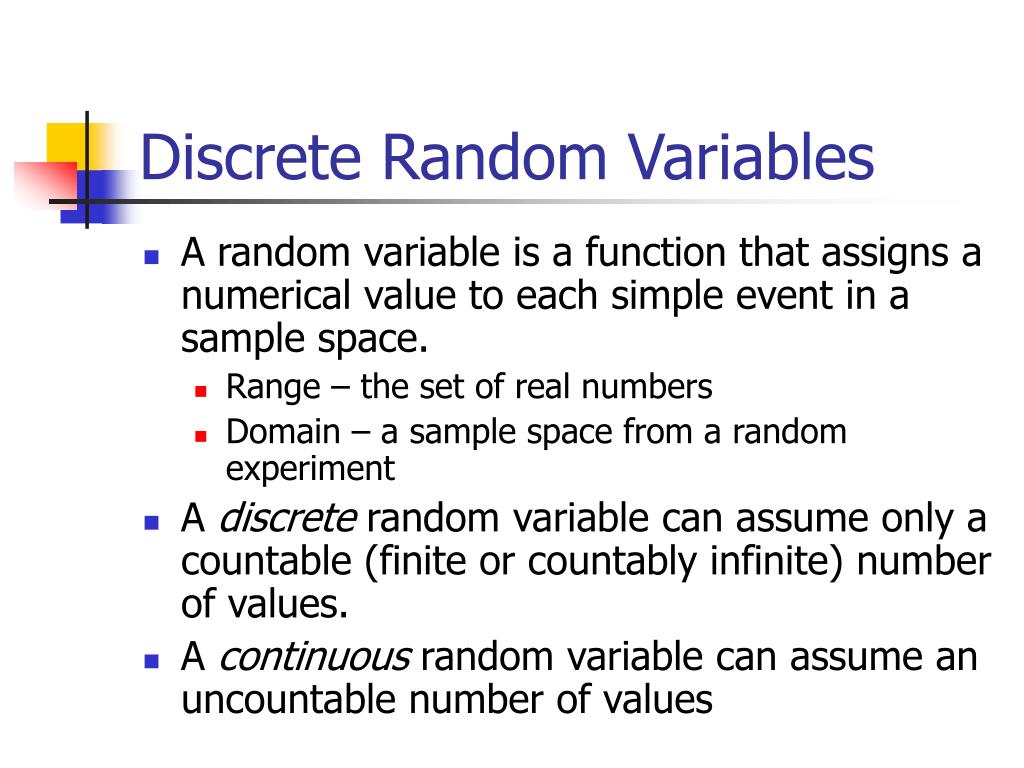
Discrete Random Variables. A random variable is a function that assigns a numerical value to each simple event in a sample space. Range – the set of real numbers Domain – a sample space from a random experiment
Discrete Random Variables - slide 1
01 / 7Discrete Random Variables
1 / 17

Télécharger la présentation

Discrete Random Variables
Une image / un lien ci-dessous est fourni (tel quel) pour télécharger la présentation

Politique de téléchargement : le contenu du site vous est fourni TEL QUEL pour votre information et votre usage personnel ; il ne peut être vendu, concédé sous licence ni partagé sur d’autres sites sans l’accord de son auteur.Le contenu vous est fourni TEL QUEL, pour votre information et votre usage personnel uniquement. Téléchargez la présentation en cliquant sur ce lien. Lors du téléchargement, si vous ne parvenez pas à télécharger une présentation, l’éditeur a peut-être supprimé le fichier de son serveur.Pendant le téléchargement, si vous ne parvenez pas à obtenir une présentation, le fichier a peut-être été supprimé par l’éditeur.

F I N

Plus de contenu associé

Transcription de la présentation
  1. Discrete Random Variables • A random variable is a function that assigns a numerical value to each simple event in a sample space. • Range – the set of real numbers • Domain – a sample space from a random experiment • A discrete random variable can assume only a countable (finite or countably infinite) number of values. • A continuous random variable can assume an uncountable number of values

  2. Counting numbers • The values of a discrete random variable are countable I.e. they can be paired with the counting numbers 1,2, … • Counting numbers, 0, the negatives of counting numbers, and the ratios of counting numbers and their negatives (rational numbers) are inadequate for measuring. • Consider the square root of 2, the length of the diagonal of a square of side 1.

  3. Measuring Numbers • The values of a continuous random variable are uncountable, and hence resemble the numbers comprising a continuum or interval, needed for measuring • Measurements are always made to an interval, however small.

  4. Mass functions vs. density functions • With discrete random variables, probabilities are for ‘discrete’ points • Probability functions of discrete random variables are called probability mass functions • With continuous random variables, probabilities are for intervals • Probability functions of continuous random variables are called probability density functions

  5. Expected value of a discrete random variable • E(X) = S {x*[P(X=x)]}=S{x*p(x)} = m • Var(X) = S {(x-m)2 *[P(X=x)]} = S {(x-m)2*p(x)} = s2

  6. Laws of Expected Value E( c ) = c E ( cX) = cE(X) E(X+Y) = E(X) + E(Y) E(X - Y) = E(X) – E(Y) E(X*Y) + E(X) * E(Y) if and only of X and Y are independent

  7. Laws of Variance V ( c ) = 0 V(cX) = c2*V(X) V(X+c) = V(X) V(X+Y) = V(X) + V(Y) if and only if X and Y are independent V(X – Y) = V(X) + V(Y) if and only if X and Y are independent