Understanding Karl Marx and the Foundations of Communism
This lesson focuses on Karl Marx's contributions to political thought, particularly his analysis of capitalism through the lens of class struggle. It defines key concepts, including "manorialism," "mercantilism," and "Communism." We explore the dynamics between the bourgeoisie and the proletariat, emphasizing their roles in the capitalist system and the envisioned revolution for a classless society. Additionally, we examine the rise of communism in Russia under Lenin's leadership in 1917, detailing the subsequent civil war and transformation of landownership.

Understanding Karl Marx and the Foundations of Communism
E N D
Presentation Transcript
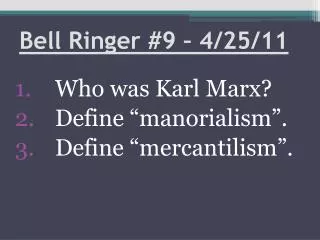
Bell Ringer #9 – 4/25/11 • Who was Karl Marx? • Define “manorialism”. • Define “mercantilism”.
Bell Ringer #8 – 4/15/11 Define “Communism” Give a nation that once represented Communism. In what year did Karl Marx write a book to outline Communist ideals.
The Bourgeoisie • Karl Marx said “middle class” merchants, the bourgeoisie (boorz-wa-zee), became more powerful and challenged nobility. • Marx credited the bourgeoisie for the creation of capitalism in Europe.
The Proletariat Class • Marx resented the bourgeoisie for controlling the means of production. • Complained the working class, called the proletariat, provided the essential labor but suffered from low wages. • Believed proletariat must win the “class struggle” by overthrowing the bourgeoisie in a violent revolution.
Keys to a Proletariat “Victory” • Communism was to be the destruction of Capitalism, to create a “classless” society. • People would share ownership of production, workers would topple the bourgeoisie, and society would succeed w/o government.
Rise of Communism in Russia • Under the leadership of Vladimir Lenin in 1917 the Bolsheviks (Communists) overthrew the Russian gov’t. • Civil war ensued for over 4 years and large estates were broken up. • Labor was relocated to certain industries.
Partner Assignment • Read Page 392 – “A Brave New World” • Copy and answer questions 1 and 2 • Due Tues 4/26