
Cell Interactions: Understanding the Extracellular Space
E N D
Presentation Transcript
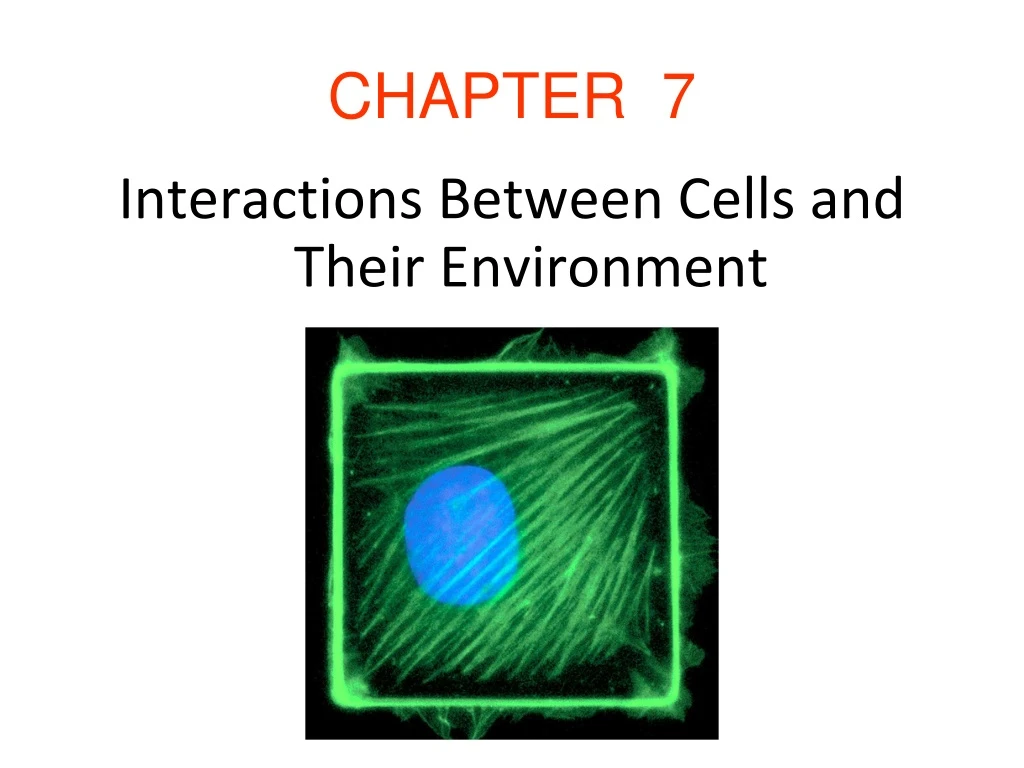
CHAPTER 7 Interactions Between Cells and Their Environment
Introduction • Cells interact with extracellular material to form defined tissues. • These interactions are crucial to the formation of epithelial tissue and connective tissue, which are crucial for various cellular activities.
7.1 The Extracellular Space (1) • The glycocalyx (cell coat) is formed from carbohydrate projections form the plasma membrane. • Glycocalyx mediates cell-cell and cell-substratum interactions.
The Extracellular Space (2) • The extracellular matrix (ECM) is an organized network beyond the plasma membrane. • It often plays a regulatory role in determining shape and activities of the cell.
The Extracellular Space (3) • ECM (continued) • The basement membrane (basal lamina) is a continuous sheet that underlies epithelial tissue and surrounds blood vessels. • Helps maintain cells attached. • Serves as substratum for cell migration. • Forms a barrier to macromolecules.
The Extracellular Space (4) • Collagens – fibrous glycoproteins found only in the ECM. • Collagen is the most abundant protein in the human body. • Provide high tensile strength. • Each collage is restricted to particular locations in the body. • All collagens are a trimer of polypeptide chains wound around each other.
The Extracellular Space (5) • Collagens (continued) • Provide the insoluble framework that determines mechanical properties of the matrix. • Abnormalities in collagen formation lead to serious disorders.
The Extracellular Space (6) • Not all collagens form fibrils. • Collagen type IV is non-fibrillar, and is restricted to the basement membrane.
The Extracellular Space (7) • Proteoglycans – protein-polysaccharide complex, with a the core protein attached to glycosaminoglycans (GAGs). • Have a repeating disaccharide structure. • Negatively charged GAGs attract lots of cations, which in turn attract water forming a porous, hydrated gel.
The Extracellular Space (8) • Fibronectin (Fn) – a linear array of distinct polypeptides giving it a modular structure. • Each polypeptide is about 30 Fn modules. • Fn modules are found in other proteins too. • Fn has binding sites for other components of the ECM. • Fn guides migrating cells during embryogenesis.
The Extracellular Space (9) • Laminins – extracellular glycoproteins consisting of three polypeptide chains linked by disulfide bonds. • Help cell migration during development. • Components of basement membranes.
The Extracellular Space (10) • Dynamic Properties • The ECM can be stretched during tension. • ECM materials degraded by matrix metalloproteinases (MMPs). • MMPs possibly involved in tissue remodeling, embryonic cell migration, wound healing , and formation of blood vessels.
7.2 Interactions of Cells with Extracellular Materials (1) • Integrins – family of membrane proteins composed of heterodimers with α and ß subunits. • Have a major role in integrating extracellular and intracellular environments. • Another role is adhesion of cells to their substratum or other cells.
Interactions of Cells with Extracellular Materials (2) • Integrins (continued) • Linkage between integrins and their ligands mediates adhesion between cells and their environment. • Binding of proteins to integrins is facilitated by tripeptide RGD.
Interactions of Cells with Extracellular Materials (4) • Integrins (continued) • Cytoplasmic domains of integrins contain binding sites for a variety of cytoplasmic proteins. • Integrins make the connection between the ECM and the cytoskeleton.
Interactions of Cells with Extracellular Materials (5) • Focal adhesions – scattered, discrete sites for cell adhesion to their substratum in vitro. • They may act as a type of sensory structure. • Are also implicated in cell locomotion.
Interactions of Cells with Extracellular Materials (6) • Hemidesmosomes – basal attachments of epithelial cells to the basement membrane in vivo. • Contain a dense plaque with filaments consisting of keratin. • Keratin filaments are linked to the ECM by membrane-spanning integrins.
7.3 Interaction of Cells with Other Cells (1) • Cells have surface-recognition sites that maintain organization
Interaction of Cells with Other Cells (2) • Selectins – family of integral membrane glycoproteins that bind to sugars on the surface of cells.
Interaction of Cells with Other Cells (3) • Selectins (continued) • Contain a small cytoplasmic domain, a single membrane-spanning domain, and a large extracellular segment. • Three types: • E-selectin – on endothelial cells. • P-selectin – on platelets and endothelial cells. • L-selectin – on white blood cells.
Interaction of Cells with Other Cells (4) • Immunoglobulin superfamily (IgSF) – most proteins are involved in immune functions. • Most IgSF molecules mediate interaction of lymphocytes with cells required or immune response.