
70 likes | 177 Vues
The phone meeting held on March 7, 2007, led by Terry Hart, provided a comprehensive overview of the latest advancements in the TriP-t test stand. Key hardware tests revealed that the TriP-t functions well with zero suppression signal sequences. Completed tests with signal generators and variable level pods demonstrated effective performance. Next steps include validating signal integrity and buffering events during digitization. Ongoing developments aim to refine the digitization time and assist firmware development with ongoing testing protocols.
E N D
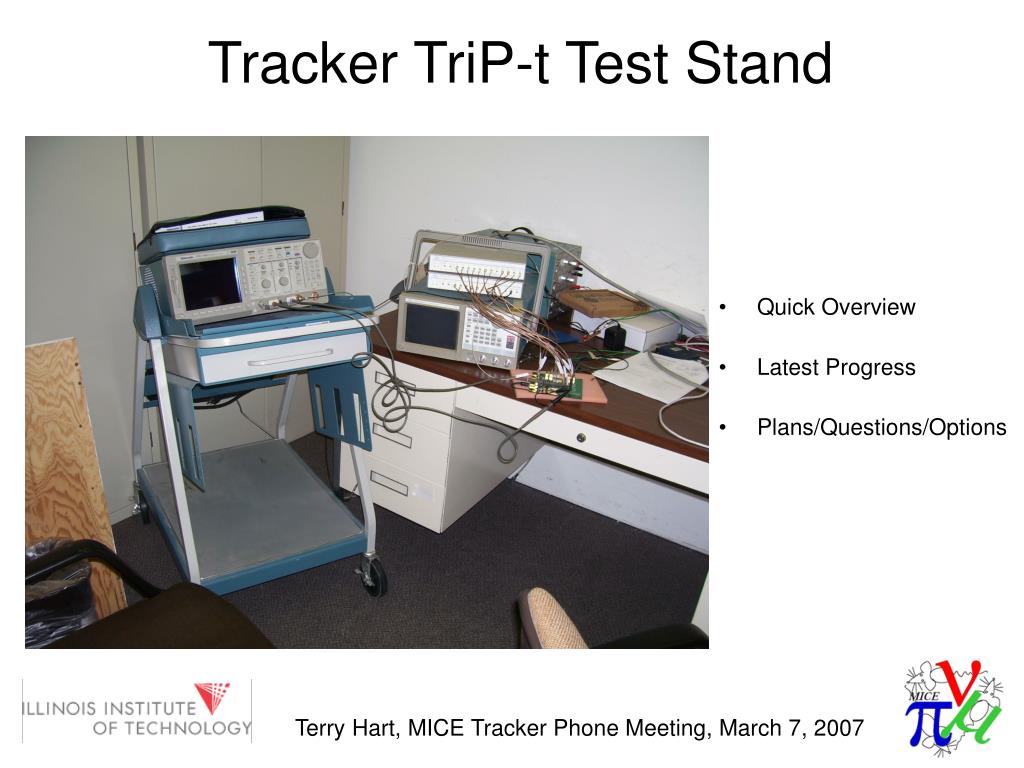
Tracker TriP-t Test Stand • Quick Overview • Latest Progress • Plans/Questions/Options Terry Hart, MICE Tracker Phone Meeting, March 7, 2007
Hardware Tests of Increasing Fraction of Recorded Muons • Completed TriP-t test stand • 2 DG2020 Signal Generators • 2 Tektronix P3420 Variable Level Pods • Test board containing TriP-t chip • Fed signals into TriP-t test board. First results: TriP-t seems to function with input zero suppression signal sequence . Next steps: - Check output signal integrity to see if input signals were digitized. - Check if buffering events works.
Data Generator TriP-t Test Board Output Pods
Preamplifier Signals TriP-t Chip Signal Inputs Pipeline Control Signals Program Interface Signals
Test Procedure • Inject charge on input channels every 324 ns. • 4 channels in gate #1 (1,15,16,31) • 3 channels in gate #2 (1,15,31) • 3 channels in gate #3 (15,16,31) • 3 channels in gate #4 (1,16,31) • Check signal outputs on oscilloscope. Pipeline and 4-level analog buffer running during digitization and need to work for a successful test. Terry Hart, MICE Tracker Phone Meeting, March 7, 2007
Tek00000.wfm is TriP-t output Tek00001.wfm is PR1 (start pipeline readout) Tek00002.wfm is MUXCLK Tek00003.wfm is PR1 associated with MUXCLK Tek00004.wfm is TriP-t output Tek00005.wfm is TriP-t for 4 injections Tek00006.wfm is PR1 for 4 injections • PR1 starts pipeline readout • Analog outputs from pipeline • are correct • Digitization times • - 4 channels => 2268 ns • - 3 channels => 1620 ns • Recall inputs • 4 channels in gate #1 (1,15,16,31) • 3 channels in gate #2 (1,15,31) • 3 channels in gate #3 (15,16,31) • 3 channels in gate #4 (1,16,31)
Conclusions and Plans • Test stand has demonstrated that TriP-t can • Run pipeline during digitization • Store data in 4-level analog pipeline for later readout • Next steps • Try to reduce digitization time by ending readout after last hit channel. • Continue to use test stand to guide firmware development. • Perhaps set up AFE-IIt test stand to test entire board. (Can charge be injected into channels as with the TriP-t test stand?). Terry Hart, MICE Tracker Phone Meeting, March 7, 2007