Bell Work
This lesson focuses on the analysis of angles formed by intersecting lines, including calculating angle measures and exploring special angle relationships. Students will learn how to classify angles as acute, right, obtuse, or straight and identify various angle types like supplementary and complementary angles. Through exercises involving angle bisectors and algebraic expressions for angle measures, students will develop skills needed to solve for unknown angles and understand geometric concepts. Key vocabulary terms and their definitions will also be covered to reinforce learning.


Bell Work
E N D
Presentation Transcript
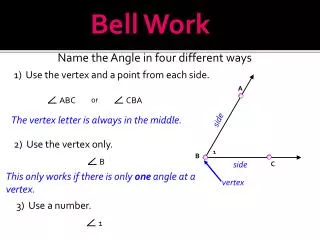
Bell Work Which angles and D as their vertex? Give two other names for <ABD. Does <BDC appear to be acute, right, obtuse, or straight? Find the value of x and m<ABD if m<ABC = 71, m<DBC = 2x – 3, and m<ABD = 3x + 4. Suppose MN bisects <RMQ, m<RMN = x + 2, and m<NMQ = 2x – 3. Find the value of x and m<RMQ. G B 1 2 A 3 D C
Vocabulary • Read pages 53 – 55 and define the following terms: • Perpendicular lines • Adjacent angles • Vertical angles • Linear pair • Supplementary angles • Complementary angles
Perpendicular Lines • When two lines intersect, they form four angles, but not always right angles. • Perpendicular lines are special intersecting lines that form four right angles.
Patty Paper Activity • Pg. 54 Angle Relationships
Vertical Angles are Congruent • In the figure, GH and JK intersect at I. Find the value of x and the measure of <JIH. G J 16x - 20 I 13x + 7 H K
Angles • Supplementary angles are two angles whose measures add up to 180°. These are not necessarily a linear pair, but can be. • Complementary angles are two angles whose measures add up to 90°. These are not necessarily adjacent angles, but can be.
Example • The measure of the supplement of an angle is 60 less than three times the measure of the complement of the angle. Find the measure of the angle.
Check for Understanding • Pg. 58 # 6 – 14
Homework • Pg. 59 # 15 – 33
Review for test • Pg. 61 – 64 # 1 – 42