A Motion Planner for the Human Hand
190 likes | 302 Vues
This project explores advanced motion planning techniques for simulating human hand movements through a 20-degree of freedom skeleton. By defining a 20-dimensional configuration space, we enable the transition between user-defined poses while mitigating collisions and milestones. Sampling strategies, including adaptive Gaussian random sampling, enhance the connectivity of sampled configurations, while motion smoothing techniques greatly improve the realism of generated hand motions. Future work aims to refine the skeleton model for better realism and incorporate dynamics to further enhance control.


A Motion Planner for the Human Hand
E N D
Presentation Transcript
A Motion Planner for the Human Hand Project by: Qi-Xing & Samir Menon
Motion Planning for the Human Hand θi θ2 θ20 θ1 Find Parametrization Vector, Θ{θ1, θ2..} Generate Hand Skeleton Define Configuration Space User defines two poses – Find Path & Smoothen to get Realistic Motion Sample Configuration Space for Milestones & Collisions Connect Adjacent Configurations
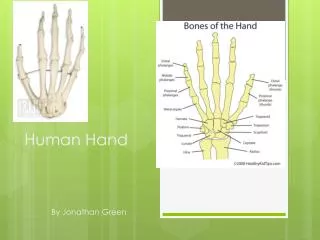
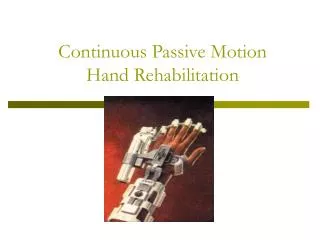
The Human Hand • Motion is induced by the application of musculo-skeletal control • We demonstrate planned motion of a human hand • Simulated hand has a 20 degree of freedom skeleton • Control is applied to the joint angles of the skeleton • Planning takes place in 20-dimensional joint configuration space • The planned path is executed in a simulated model of the human hand
The Hand Skeleton • The human hand may be modeled using a 20 DoF skeleton parameterization • Configuration of the human hand is represented by a 20 dimensional joint angle vector Hand Space
Modeling the Hand • ‘Hand-space’ models an actual human hand • The hand is represented by a mesh representation of a laser scanned hand • The parameterization allows the emulation of a real hand Hand Space Configuration
Configuration Space • Hand motion is in 20 dimensional configuration space along the planned path θi θ20 Disallowed Hand Config = C–Space Obstacle Θ1 Path of Motion Θ2 θ2 Θ3 Θ4 Θ5 Θi={θ1, θ2,…, θ20} Represents a hand configuration θ1 θ0 Milestones = Sampled Hand Configuration
Uniform Sampling • A uniformly random sampler θi θ20 θ2 θ1 θ0
Adaptive-Gaussian-Random Sampling • An adaptive gaussian sampler θi θ20 Gaussian Sample θ2 Adaptive Sample Random Sample θ1 θ0
Connecting Samples • Obtain a roadmap in the form of a search graph • Connect each sample to 10 closest samples and check for collision • Reject connections with collisions θi θ20 θ2 θ1 θ0
Collision Detection Strategy θi θ20 θ2 Collision!!! Path Added To Roadmap! θ1 θ0
Planning Hand Motion • Add start and goal configuration nodes to graph • Search for a path in the graph Resulting Path is Jerky due to imperfect sampling!! θi θ20 θ2 Goal θ1 Start θ0
Planning Hand Motion (contd.) • Video of jerky motion
Smoothing Motion θi θ20 Smooth Path is obtained!! θ2 Goal θ1 Start θ0
Smoothing Motion (contd.) • Video of smooth motion
Demo Eg.4 • System demo Eg.1 Eg.2 Eg.3
Discussion • Smoothing the path greatly improves motion quality • Adaptive Gaussian Sampling can drastically reduce the required samples but it also requires more precomputation • Straight line motion in higher dimensional space produces better quality than curved or spline motion.
Future Work • Areas for improvement: • The project may be extended to involve: • Control applied to muscular configuration space • Improved skeleton that closely matches a real hand • System dynamics such as inertia and damping