Enhancing Teacher-Student Relationships: Insights from Research
This compilation of key educational references emphasizes the importance of effective teacher-student relationships and motivation in education. Cornelius-White’s meta-analysis highlights learner-centered approaches, while Schunk et al. provide essential insights into motivation and learning strategies. Groundwater-Smith, Ewing, and Le Cornu discuss teaching dilemmas, offering practical guidance for future educators. Together, these resources underscore the challenges and innovations in developing meaningful connections in the classroom, ultimately enhancing learning outcomes for students.

Enhancing Teacher-Student Relationships: Insights from Research
E N D
Presentation Transcript
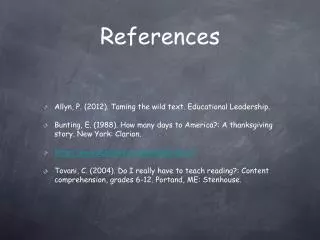
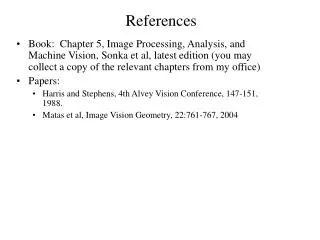
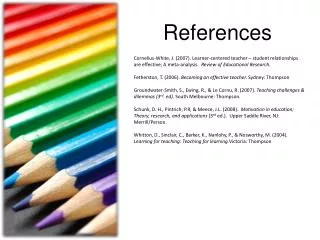
References Cornelius-White, J. (2007). Learner-centered teacher – student relationships are effective; A meta-analysis. Review of Educational Research. Fetherston, T. (2006). Becoming an effective teacher. Sydney: Thompson Groundwater-Smith, S., Ewing, R., & Le Cornu, R. (2007). Teaching challenges & dilemmas (3rd. ed). South Melbourne: Thompson. Schunk, D. H., Pintrich, P.R, & Meece, J.L. (2008). Motivation in education; Theory, research, and applications (3rd ed.). Upper Saddle River, NJ: Merrill/Person. Whitton, D., Sinclair, C., Barker, K., Nanlohy, P., & Nosworthy, M. (2004). Learning for teaching: Teaching for learning.Victoria: Thompson