Classical Plasmid DNA preparation
The classical plasmid DNA preparation method, introduced by Birnboim and Doly in 1979, employs alkaline lysis with SDS (sodium dodecyl sulfate) to extract plasmid DNA from bacterial cells. This technique effectively disrupts cell walls and denatures chromosomal DNA and proteins under high pH conditions. The circular plasmid DNA remains entwined, allowing for strand realignment after lysis. The process includes centrifugation, followed by purification steps using phenol/chloroform and ethanol precipitation to isolate high-quality plasmid DNA for further applications in molecular biology.

Classical Plasmid DNA preparation
E N D
Presentation Transcript
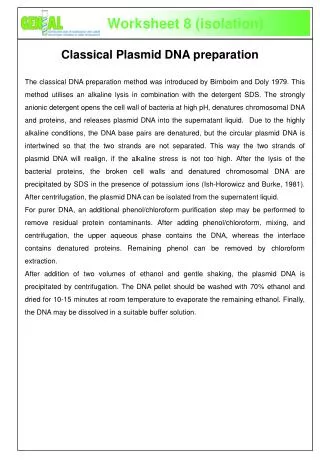
Classical Plasmid DNA preparation The classical DNA preparation method was introduced by Birnboim and Doly 1979. This method utilises an alkaline lysis in combination with the detergent SDS. The strongly anionic detergent opens the cell wall of bacteria at high pH, denatures chromosomal DNA and proteins, and releases plasmid DNA into the supernatant liquid. Due to the highly alkaline conditions, the DNA base pairs are denatured, but the circular plasmid DNA is intertwined so that the two strands are not separated. This way the two strands of plasmid DNA will realign, if the alkaline stress is not too high. After the lysis of the bacterial proteins, the broken cell walls and denatured chromosomal DNA are precipitated by SDS in the presence of potassium ions (Ish-Horowicz and Burke, 1981). After centrifugation, the plasmid DNA can be isolated from the supernatent liquid. For purer DNA, an additional phenol/chloroform purification step may be performed to remove residual protein contaminants. After adding phenol/chloroform, mixing, and centrifugation, the upper aqueous phase contains the DNA, whereas the interface contains denatured proteins. Remaining phenol can be removed by chloroform extraction. After addition of two volumes of ethanol and gentle shaking, the plasmid DNA is precipitated by centrifugation. The DNA pellet should be washed with 70% ethanol and dried for 10-15 minutes at room temperature to evaporate the remaining ethanol. Finally, the DNA may be dissolved in a suitable buffer solution.