Download
1 / 11
110 likes | 239 Vues
The Scientific Revolution marked a profound shift in the way people approached science and technology, signifying a key part of the Enlightenment. Spanning from the late 15th to the late 17th century, this complex movement was defined by the work of brilliant minds such as Nicolaus Copernicus, Johannes Kepler, Galileo Galilei, and Isaac Newton. These thinkers challenged long-standing beliefs about the cosmos, transitioning from the Ptolemaic geocentric model to the heliocentric system and laying the groundwork for modern physics and astronomy.

E N D
The Scientific Revolution By: Amanda Smith and LinneaCalzada-Charma
Intro to the Scientific Revolution • Part of The Enlightenment • Changed the way people though and approached science and technology • Was not rapid • Complex movement with brilliant people but only theories and experiments • Poland, Italy, Bohemia, France, and Great Britain
Nicolaus Copernicus • Lived from 1473-1543 • Polish astronomer • Developed advances in mathematics and methods of calculation • Published On the Revolutions of the Heavenly Sphere
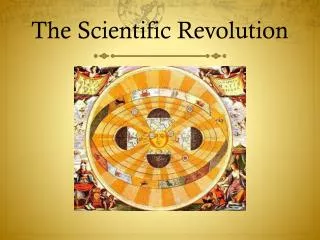
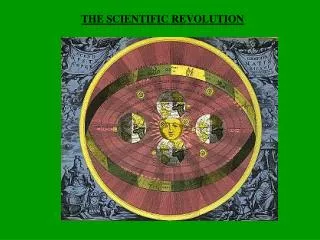
Created the Heliocentric solar system • Was not accepted by the Church • Aristotle and Ptolemy created Geocentric system and was adopted as Church doctrine
The Ptolemaic System • Almagest (150 C.E.) – explanation of the Earth in the heavens with mathematical astronomy • Aristotle worked with physical cosmology
Ptolemy worked mathematics • Together created theory of Geocentricism (Earth = center of the universe) • Geocentricism = more religious belief because they assumed that heavenly matter made planets orbit
Tycho Brahe • Lived from (1546-1601) • Made no major contributions to science • Laid groundwork for Kepler’s discoveries • Believed in Geocentricism • Created scientific instruments to observe planets with the naked eye
Johannes Kepler • German astronomer • Student/assistant of Brahe • When Brahe died, Kepler inherited his scientific instruments • Supported Heliocentric system • Mathematical findings supported elliptical orbits
Three Laws of Planetary Motion • Kepler used Brahe’s data to write Three Laws of Planetary Motion • Elliptical vs. circular • Kepler published The New Astronomy (1609) • After Kepler’s book, questions arose about how planets stayed in orbit
Galileo Galilei Lived from 1564-1642 Italian mathematician and philosopher First to use a telescope created the concept of the universe with mathematics Mathematics regularity
Isaac Newton • 1642-1727 he established a base for physics • 1687 The Mathematical Principles of Natural Philosophy • Physical objects moved in mutual attraction (gravity) • Proved gravity mathematically