Download
1 / 24
240 likes | 350 Vues
This document explores essential vocabulary connected to the Scientific Revolution, a pivotal era that reshaped human understanding of the natural world. Key terms such as Revolution, Enlightenment, Rationalism, Tolerance, and Deism highlight the movement toward individual reasoning and the questioning of traditional beliefs. Discover how leading figures like Copernicus and Galileo contributed to new scientific ideas that challenged old views like the geocentric theory. This analysis provides insight into the shift in perspectives regarding politics, philosophy, and the cosmos.

E N D
The Scientific Revolution Mr. Mizell
Unit 4 Vocabulary, Copy Down • Revolution – a drastic change in the political and social organization of a country • Enlightenment – political movement that supported the power of individuals to solve problems using reason • Natural Laws – patterns and explanations of the world discovered through reason. • Rationalism - Reason, and not tradition, is the source for all knowledge • Philosophy – investigation of the truths and principles of knowledge and being
Unit 4 Vocabulary, Copy Down • Tolerance – being fair and objective to differing views or people • Rights – guarantees based on moral principles • Laissez-faire – governments do not get involved in the economy/businesses; “hands off” • Contract – agreement between two or more groups (people and a government) • Inalienable – not able to be taken away. Absolute.
Unit 4 Vocabulary, Copy Down • Conservative – those who want to preserve traditional power of monarchies • Liberal – those who want to give more power to elected officials • Constitution – political principles/laws that govern a nation • Deism – belief in a Supreme Being that created the world but is indifferent to it • Absolutism – belief that all power rests with a monarch who has a divine right to rule by God. • Constitutional Monarchy – a monarchy where the ruler’s power is limited by law/constitution • Republic – type of government where power is in the hands of representatives elected by the people
EQ: How did the Scientific Revolution change the way people viewed the world?
Historical Change • Renaissance – Curiosity, Secularism, Realism • Reformation – Challenge the way we think about God • Age of Exploration – Explored world. Now, time to explore Universe • Scientific Revolution – How people view their place in the universe; explore universe/science
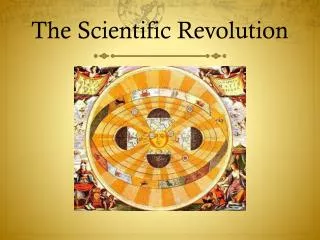
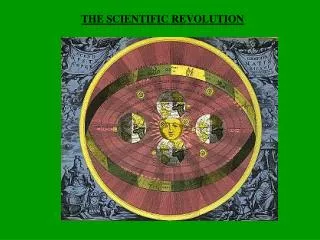
Old Views • Geocentric Theory - Earth was center of universe, did not move • Everything (sun, planets )revolved around it • Stars were fixed (did not move)
Why Believe this? • Greek philosophers said this • Held in high esteem • Biblically based – Catholic Church says so
What was the Scientific Revolution? • A new way of thinking about the natural world and universe (using rationalism and mathematics)
Heliocentric Theory • Nicolas Copernicus, astronomer • Says Earth and planets revolve around the Sun (in the center) in circles
Orbits of Planets • Johannes Kepler, astronomer • Used mathematical formulas to understand planets’ orbits • Planets move in ellipses
Telescopes & Gravity • Galileo • Discovered Jupiter’s moons with telescope • Gravity - Objects fall at same rate
Scientific Method • A logical procedure for gathering and testing ideas • Not enough to think about something. You need to Experiment
Natural Laws • Set forth by Isaac Newton • Says universe is linked by Natural Laws and gravity • Universe works perfectly like a clock • God was creator of orderly universe
Overall effects of the Scientific Revolution • “De-spiritualized” the universe • Deistic view of God • Religion’s power erodes to an extent
Directions • Work on Scientific Revolution Document Analysis silently • Work or read silently when finished