Understanding Currency Exchange Rates: Nominal, Real, and Market Dynamics
This guide explores the complexities of currency exchange rates, including nominal and real exchange rates. It discusses how exchange rates affect trade balances, with concepts such as appreciation and depreciation of currency. Learn about fixed versus floating exchange rates, purchasing power parity, and the determinants affecting currency movements. The analysis also encompasses market graphs for dollars and euros, demonstrating how shifts in demand and supply influence exchange rates and international trade. Perfect for anyone looking to deepen their understanding of global finance.

Understanding Currency Exchange Rates: Nominal, Real, and Market Dynamics
E N D
Presentation Transcript
Exchange Rates Graphing Currency Movements
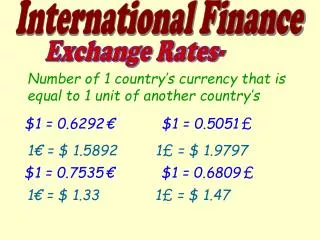
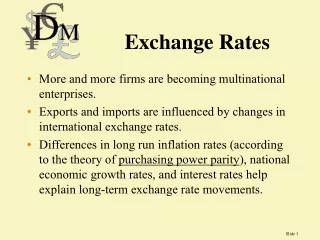
Exchange Rates • Nominal exchange rate-rate at which a person can exchange currency • Example: Dollars for Euros => Give $1.35 dollars to receive 1.0 Euro • Real exchange rate- rate at which a person can trade goods & services between countries • Example: Rice in Japan vs. Rice in USA • Purchasing Power Parity = “law of one price”
Changing Exchange Rates • Appreciation =increase in value of currency • Dollar appreciates => Imports cheaper & Exports more expensive • Leads to larger Trade Deficit (NX↓ ) & AD shifts left • Depreciation = decrease in value of currency • Dollar depreciates => Imports more expensive & Exports cheaper • Leads to smaller Trade Deficit (NX↑) & AD shifts right
Flexible Exchange Rates • FIXED exchange rates • a set, agreed upon relationship between currencies or a currency value expressed in a precious asset (gold) • Example: Chinese Yuan • FLOATING exchange rates • free market rates- supply & demand determine exchange rates • Example: almost all major currencies
S1 House of D1 Foreign Exchange This label determines the market you are graphing: Market for US dollars Priced in Euros Graphing Exchange Rates • Currency are priced in other currencies • All FX trades are executed in the market for foreign exchange • Hint: pretend a “house of foreign exchange” is located on a remote island where all currency is exchanged…. Market for Dollars Euro Price of a dollar .75 Euro -------------- -------------- Q1 Qty of Dollars
Products should cost the same in real terms in each country U.S. Income Rises Demand Imports Demand Foreign Currency Determinants of Exchange Rates 1.Changes in Consumer Tastes 2. Relative Income Changes 3. Relative Price Level Changes “Purchasing Power Parity Theory” 4. Relative Real Interest Rates 5. Speculation & Investment
Market for Dollars Market for Euros S S S S Euro Price 1 1 Dollar Price 1 1 of a dollar of a Euro .75 -------------- Euro -------------- 1.35 Dollars -------------- -------------- D D D D 1 1 1 1 Q Q Qty of Euros 1 Qty of Dollars 1 Event: US invents new breakthroughs in technology products
The Market for Foreign Exchange P Market for Dollars S S1 3 2 1 Euro price of 1 $Dollar Dollar depreciates Supply of US dollars increases Dollar depreciates Against Euro D Q Quantity of dollars