Understanding the Classification of Living Things: A Dive into Taxonomy
120 likes | 251 Vues
This overview explores the classification of living organisms, emphasizing the importance of taxonomy in science. Taxonomy categorizes life forms based on their relationships and evolutionary history, providing a systematic approach for scientists to communicate. It introduces the concept of binomial nomenclature, developed by Carolus Linnaeus, which gives each organism a unique two-part name in Latin. The classification system is organized hierarchically into domains, kingdoms, and lower categories, ensuring a clear understanding of biological diversity across six kingdoms: Archaebacteria, Eubacteria, Protista, Fungi, Plantae, and Animalia.


Understanding the Classification of Living Things: A Dive into Taxonomy
E N D
Presentation Transcript
Classification of Living Thingschapter 18 March 17, 2014
Overview • Taxonomy • Why Classify? • Binomial Nomenclature • The Heirchacal System • The Five Kingdoms
Taxonomy • Taxonomy is the branch of science that identifies and categorized organisms.
Why do we need to Classify? • Imagine your computer or IPod…are all of your songs and files in a single folder or do you have them grouped in some way?? • It is best to organize and group items so that you can find them easier or easily see their relationship to other items.
Why do we need to Classify? • Classifying living things sets up an organized system so scientists can communicate. • The classification system also shows evolutionary linkages between organisms.
Scientists also need a way to NAME organisms • The “common names” used by people can sometime be misleading or confusing. • In order to communicate effectively, biologists need a CONSISTENT naming protocol.
Consider this…. • Are all “Grey Wolves” gray? • Are all “Black Bears” black? • Which is more venomous- a water moccasin or a cottonmouth? • Grey wolves can be b/w & grey: black bears can be brown or gray
Binomial Nomenclature • The system was developed by Carolus Linnaeus who used Greek and Latin names for organisms. • By, binomial we simply mean that all organisms are given scientific names consisting of a genus name and a species name, often in Latin.
Binomial Nomenclature • For example, we humans are called Homo sapiens. Homo is our genus name and sapiens is our species name. • Homo means “man” and sapiens means “wise”. • Genus is capitalized, species is lowercased
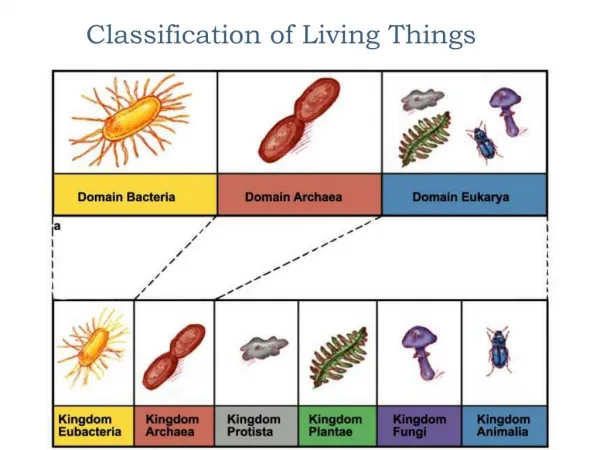
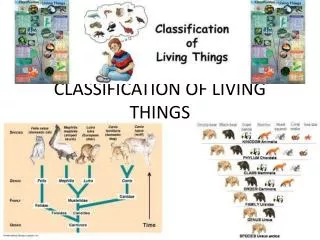
Classification Groupings • Domain • Kingdom • Phylum • Class • Order • Family • Genus • Species • How can I remember this??? • Dumb King Phillip Came Over From GreatSpaghetti • As we go from top to bottom, the groups get larger and more specific. • 3 Domains: Achea, Eubacteria, Eukaryrotes
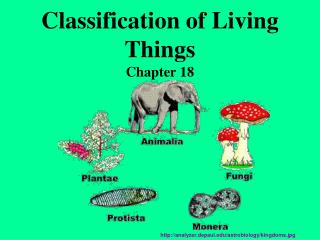
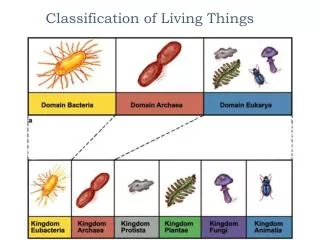
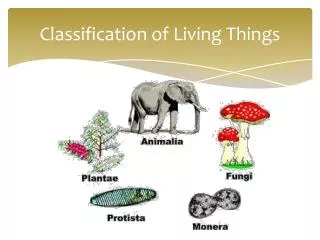
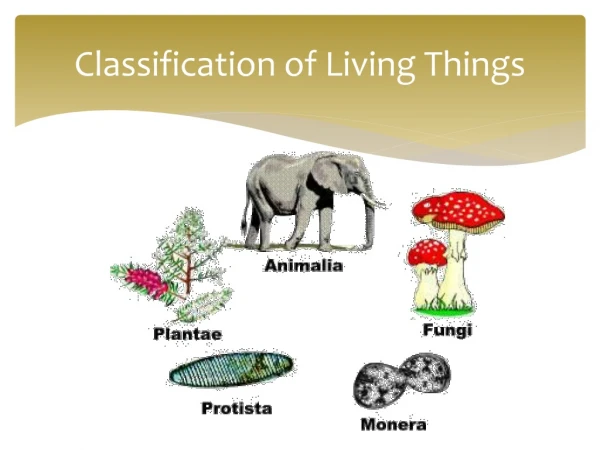
The Kingdoms • There are currently 6 kingdoms- all organisms can be placed into one of those 6. • Classification into a kingdom is based on certain criteria: • Number of cells • How it obtains energy • Type of cell
The SixKingdom System • Archaebacteria • Eubacteria • Protista • Fungi • Plantae • Animalia