Understanding Taxonomy: Classification of Living Things
100 likes | 229 Vues
Delve into the world of taxonomy and binomial nomenclature to categorize organisms in a logical hierarchy. Explore Linnaeus’s classification system, cladograms, and the significance of kingdoms and domains in classifying living beings.


Understanding Taxonomy: Classification of Living Things
E N D
Presentation Transcript
Classification of Living ThingsCh. 18 Mrs. Griffin
Before we begin…… • What is the scientific name for the human species? • Homo sapiens • What do you think the common names for Felis catus and Canis familiaris? • Cat, dog • In each case, what does the first of the two names refer to? • The genus • What do the two names together refer to? • The species • Which group is more inclusive? • Genus.
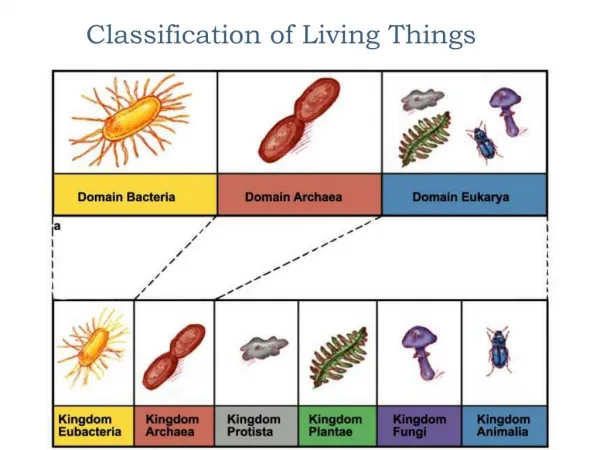
Before we begin… • To study the diversity of life, biologists use a classification system to name organisms and group them in logical order. • The science of classifying organisms and assigning each organism a universally excepted name is known as taxonomy. • One tool used to identify unfamiliar organisms is a dichotomous key…. Vocabulary to know: taxonomy, binomial nomenclature, genus, taxon, family, order, class, phylum, kingdom, cladogram, the three domains and six kingdoms.
Early classification systems • “Oak with deeply divided leaves that have no hairs on their undersides and no teeth around their edges.” • Explained in great detail, very long. • Carolus Linnaeus- Swedish botanist developed two-word naming system (binomial nomenclature). • Linnaeus’s hierarchical system of classification included seven levels. From largest to smallest- kingdom, phylum, class, order, family, genus and species.
Binomial Nomenclature • Developed by Linnaeus • Two-name system. The scientific name is always written in italics, the first word is capitalized, and the second word is lowercased. • First name (genus); second name (species)
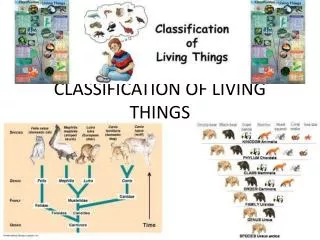
Includes 7 levels: Kingdom Phylum Class Order Family Genus Species Linnaeus’s system of classification
Linnaeus’s system of classification, Figure 18-5 • Does the coral snake belong in the Phylum Chordata and the Kingdom Animalia? • Yes • Does the Albert Squirrel belong in the Family Ursidae? • No • Remember- broad to specific (starting from the top down to the bottom).
Classification using cladograms Points where characteristics arose. Characteristics that appear in recent parts of a lineage but not in its older members are called derived characteristics. These characteristics can be used to construct a cladogram.
Let’s Review • What is classification? • Why is classifying living things important? • What is taxonomy? • Describe binomial nomenclature and how are scientific names written? • Linnaeus’s hierarchical system of classification included seven levels, what are they?