Chapter 1: An Introduction to Physiology
570 likes | 791 Vues
Chapter 1: An Introduction to Physiology. -physiology: the study of the functions of living things. 1. skeletal 2. articular 3. muscular 4. digestive 5. respiratory 6. urinary 7. reproductive 8. circulatory 9. nervous 10. integumentary 11. endocrine.


Chapter 1: An Introduction to Physiology
E N D
Presentation Transcript
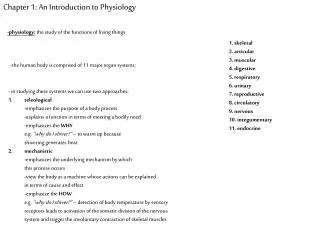
Chapter 1: An Introduction to Physiology -physiology: the study of the functions of living things 1. skeletal 2. articular 3. muscular 4. digestive 5. respiratory 6. urinary 7. reproductive 8. circulatory 9. nervous 10. integumentary 11. endocrine -the human body is comprised of 11 major organ systems: • - in studying these systems we can use two approaches: • teleological • -emphasizes the purpose of a body process • -explains a function in terms of meeting a bodily need • -emphasizes the WHY • e.g. “why do I shiver?” – to warm up because • shivering generates heat • mechanistic • -emphasizes the underlying mechanism by which • this process occurs • -view the body as a machine whose actions can be explained • in terms of cause and effect • -emphasize the HOW • e.g. “why do I shiver?” – detection of body temperature by sensory • receptors leads to activation of the somatic division of the nervous • system and trigger the involuntary contraction of skeletal muscles
-physiology is closely related to anatomy – because structure and function are closely related -physiological mechanisms are made possible because of the structure and design of a body part -some relationships are obvious – e.g. structure of the elbow as a hinge joint -others are more subtle – e.g. interface between the air and the blood in the lungs -air sac structure + capillary bed - 300 million air sacs + associated capillaries provides a total surface area for gas exchange = tennis court
Life: Levels of Organization • Atoms • Molecules • Macromolecules • Organelles • Cells • Tissues • Organs • Organ systems • Organism
Organizational Levels 1. chemical or molecular: 4 major elements within the body -99% of the total number of atoms within the body -C, N, O and H -molecular composition - 67% of our bodies is water
Atom = smallest unit of an element that still retains the chemical & physical properties of that element i.e. really, really, really tiny thing! -composed of: protons = one positive charge, 1 atomic mass unit (1.673x10⁻²⁴g) electrons = one negative charge, no mass (9.109x10⁻²⁸g) neutrons = no charge, 1 atomic mass unit -elements are grouped on a Periodic Table of Elements -the elements are grouped according to physical and chemical characteristics -on the chart each element is associated with a letter, an atomic number & an atomic mass -each atom is comprised of a nucleus of protons and neutrons + orbiting electrons
Periodic Table of Elements IA IIA IIIA IVA VA VIA VIIA VIII http://www.chemicalelements.com/ http://periodic.lanl.gov/default.htm
Li 7 3 atomic symbol atomic mass (weight) e.g. # protons (e-) = 6 # pr+6 + #No 6 = 12 C 12 6 atomic number e.g. # protons (e-) = 3 # pr+3 + #No 4 = 7 Atomic mass = number of protons + neutrons Atomic number = number of protons when the element is electrically neutral ** when neutral, the number of protons and electrons are equal
Isotope: • same atomic # (same pr+, same e-) • differs only in # of neutrons 12C13C14C pr+: 6 6 6 e-: 6 6 6 No: 6 7 8** radioactive Radioactive isotope uses: -radioactive isotopes have a high neutron to proton ratio -the nuclear “glue” within the nucleus is not strong enough to hold the nucleus together = radioactivity 1. carbon dating - 14C 2. radioactive imaging - e.g. PET scanning -use of FDG – radioactive glucose tracer -18F radioactive isotope (2-fluoro-deoxy-glucose) 3. cancer treatment - 60Co
Chemical bonds -forces holding atoms together = chemical bonds -different kinds of chemical bonds – but all involve the electrons of atoms Two types of bonds: 1. Ionic 2. Covalent
Electron Configurations • Bed check for electrons • description on how are electrons organized around the nucleus of protons and neutrons? • Bohr model: Nils Bohr proposed electrons orbit around the atom’s nucleus in specific energy levels or orbits (shells) • these shells have a specific energy level – closer the electron is to the nucleus the less energy it needs to “orbit” • this model only works for smaller atoms • larger atoms are described by quantum mechanics – orbitals have energy, momentum/shape, spin and magnetic characteristics • comprised of subshells • 1st shell – closest to the nucleus only holds 2 electrons (s subshell only) • 2nd shell can hold 8 (s and p subshells – 2 + 6 electrons) • 3rd holds 18 (s, p and d subshells – 2 + 6 + 10 electrons) • 4th holds 18
an atom will always try to complete its outermost shell • basis for bonding reactions • the number of electrons the atom gains or loses to complete its outer shell = valence • chemists really only consider the electrons in the s and p orbitals as valence electrons
Molecule: • particle formed by the union of more than one atom • e.g. same kind of atom - O2 • e.g. different types of atoms - H20 Molecules are held together by either covalent or ionic bonds -these bonds form through interactions between the valence electrons
1. Ionic bond: • attraction between 2 oppositely charged atoms (ions) • e.g. Na+ and Cl- NaCl • e.g. Ca2+ and Cl- CaCl2 -positively charged ions = cations -negatively charged ions = anions -these form as one atom transfers electrons to another atom -ions may also be composed of more then one atom = polyatomic -these are treated as the same as monoatomic ions e.g. sulfate SO43-, nitrite NO2-, hydroxide OH-
-most of your group I and group II metals will form ionic bonds with the group VIIA halogens
2. Covalent Bond: • if it isn’t favorable for an atom to gain or lose an electron • it will have to share it with another • covalent bond = bond in which atoms share electrons • e.g O2, , N3 • e.g H20 • -usually forms when one atom has to lose or gain three or more • electrons • e.g. carbon would have to gain 4 valence electrons to complete its outer shell • nitrogen would have to gain 3 valence electrons • -also form between two identical atoms – e.g. nitrogen, oxygen gas
Polar and Non-polar bonds • the sharing of electrons does not have to be equal • nonpolar covalent bond = equal sharing of electrons • e.g. oxygen (O2), methane (CH4) • polar covalent bond = uneven sharing of electrons leading to a slight charge • e.g. water = H20
d- O H H d+ d+ • Water: • 60-70% of body weight • covalent bond • POLAR molecule (uneven sharing of • electrons) • polar compounds are attracted to other • the bond between one oxygen and • the hydrogens of adjacent water • molecules = Hydrogen Bond • **HB = occurs between a covalently • bonded hydrogen and negatively • charged atom a distance away
Chemical reactions: 3 types: 1. Synthesis - A + B AB (Anabolism reactions) 2. Decomposition - AB A + B (Catabolism reactions) 3. Exchange - AB + CD AD + BC -these equations must be balanced -Law of conservation of Mass or “chemical bookeeping” -i.e. the number of atoms of each element is the same before and after a chemical reaction
Chemical reactions • are made up of reactants and creates products • these reactions go on constantly within the human body = metabolism • each reaction involves changes in energy • if the reaction requires energy = endothermic (anabolism) • if it liberates energy = exothermic (catabolism) • atoms, molecules and ions are continuously moving and colliding with one another = kinetic energy • this kinetic energy if big enough (i.e. collision is large enough) can break a bond or cause a new one to form • this collision energy = activation energy • critical to the progression of all chemical reactions in our body • the more often a collision occurs the greater chance a bond will form or break
Activation Energy & Catalysts • activation energy = initial “energy investment” required to start a reaction • the reactants must absorb enough energy to cause their chemical bonds to become unstable and created new ones • as these bonds form – energy is released into the environment – if more energy is released than absorbed = heat (exothermic reaction) • two influences on AE – temperature and concentration • concentration – increasing this increases the chance of collision between atoms • temperature – heating a reaction increases the kinetic energy of the reactants – collide more often • catalysts = compounds that lower the activation energy of a reaction
Molecules of Life: • the chemicals used in metabolic reactions or those • that are produced by them can be classified into • 2 groups: • 1. Inorganic • 2. Organic
Inorganic Compounds • water • oxygen,carbon dioxide • inorganic salts
d- O H H d+ d+ Water • major component of blood, plasma, CSF etc… • role in: transporting chemicals • transporting waste products • transporting & absorbing heat • polar molecule - asymmetrical distribution of charge • liquid at room temperature – we can drink it • universal solvent for polar compounds – facilitates most chemical • reactions in the body • -water molecules are cohesive – therefore they cling together • (because of hydrogen bonding) • -this allows the even distribution of dissolved substances • throughout our system – so water is an excellent transport • medium • -the temperature of water rises and falls slowly – prevents • sudden and drastic changes of temperature in our bodies • -water requires high heat to evaporate – it cools our bodies • -frozen water is less dense than liquid water – ice floats • -water freezes from the top down – allows aquatic organisms • to survive winters
Water: • -excellent solvent for dissolution of polar and ionic substances • e.g. H20 + NaCl • in a solution – a solvent dissolves another substance called • a solute • -water is a versatile solvent because of its polar covalent bonds and its bent • shape which allows it to interact with its neighbours very well hydrophilic • ions and molecules that react with water = • ions and molecules that don’t react = hydrophobic -water + salt: the electronegative O of water attracts the +ve sodium in salt, the electropositive H attracts the –ve chlorine -the salt becomes surrounded by water molecules and the crystal lattice of salt is broken up
Solutions, Colloids and Suspensions • solution = homogenous (same) mixtures containing a relatively large amount of one compound (solvent) • e.g. sugar + water • the mixture is the same no matter where you sample it • colloid = solution of larger components called dispersed-phase particles • these particles all carry the same charge (repel each other) • their particles are larger than that of solutions • e.g. plasma proteins within the blood • suspension = solution of larger components called dispersed-phase particles • larger particles than that of colloid • if left undisturbed these particles will settle out to form a solid • e.g. red blood cells within blood • mixture = two or more types of elements or molecules physically blended together without the formation of physical bonds between them • these individual compounds can be separated by physical or chemical means • types of mixtures: combination of solutions, suspensions and colloids
Electrolytes • substances that release ions when they react with • water • -these ions will conduct electricity = Electrolytes • -created through the decomposition of ionic substances • e.g. salt • -although polar compounds can also liberate electrolytes • abundant in body fluids • source of ions eg. Na+, Ca2+, K+, Mg2+ • ions play a role in: maintaining water concentration • maintaining pH • bone development • muscle function • nerve function • ions must be maintained in a certain concentration • to maintain homeostasis Inorganic salts: Electrolyte Balance
Inorganic Acids & Bases "H+ donators" • 3 types: • 1. release H+ Acids • e.g. HCl H+ + Cl- • 2. release ions to combine with H+Bases • e.g. NaOH Na+ + OH- • 3. acids + bases Salts • e.g. HCl + NaCl H20 + NaCl "H+ acceptors"
one must consider acids & bases • in light of how they mix with water • e.g. HCl when mixed in water • dissociates into H+ ions and Cl- • ions • if a base such as NaOH is added – it will • dissociate into Na+ ions and OH- ions • - the Na+ ions will combine with the Cl- ions to • form NaCl, the H+ ions will combine with the • OH- ions to reform water.
pH Scale • measures concentration of H+ ions in a solution e.g. pH 6 = 1 x 10⁻⁶ pH 7 = 1 x 10⁻⁷ pH 8 = 1 x 10⁻⁸
Buffers: • chemical or compound that keeps the pH of a solution within • a normal range • resists pH change by taking up excess H+ or OH- ions e.g. blood = pH 7.4 “Bicarbonate buffering system” - our blood contains a small amount of carbonic acid H20 + H2CO3 H+ HCO3- H2CO3 carbonic acid excess OH- excess H+
H H H H H H H C C C C C C H H H H H H H H H H C C H H C C H C H H H H H C C H H H Organic Compounds • always contain carbon, oxygen and hydrogen • carbon can form 4 covalent bonds with other atoms • e.g. methane • carbon can also form covalent bonds with itself • forming long chain hydrocarbons • or a ring structure symmetrical charge hydrophobic (non-polar)
Organic compounds • the skeleton of carbon and hydrogen are frequently combined with other atoms and molecules = functional groups
hydrocarbon + carboxyl group “hydrophilic” H H H O carboxyl group = polar group H C C C C O- H H H • these groups confer a specific property to the organic compound • e.g. amino acid vs. nucleotide
Organic substances: 1. carbohydrates 2. lipids 3. proteins 4. nucleic acids • 1. Carbohydrates: • provide energy to cells • supply materials to build certain cell structures • stored as reserve energy supply (humans = glycogen) • water soluble • characterized H - C - OH (ratio C:H 1:2) • e.g. glucose C6H12O6 • sucrose C12H22O12 • classified by size: simple - sugars • complex – polysaccharides • -see Table 2-6 (Tortora) monosaccharides disaccharides
A. Simple carbohydrates • monosaccharides = single sugar in which the # of carbon • atoms is low - from 3 to 7 • e.g. pentose - 5 carbon sugar • hexose - 6 carbon sugar • hexose sugars: glucose • galactose • fructose • pentose sugars: ribose • deoxyribose -three ways to represent the structure of glucose 1. Molecular form 2. 3. Simplest form
A. Simple carbohydrates • disaccharide = two 6-carbon monosaccharides • -form by a dehydration synthesis reaction • -broken up by a hydrolysis reaction • e.g. glucose + glucose = maltose • e.g. glucose + fructose = sucrose • e.g. glucose + galactose = lactose
built of simple carbohydrates • e.g. glycogen • starch • cellulose • multiple, repeating monomers or • “building blocks” polymer B. Complex carbohydrates:
Starch & Glycogen • starch = storage form of glucose found in plants • -hydrolyzed into glucose • glycogen = storage form of glucose found in animals • -hydrolyzed into glucose (in liver) Cellulose • polysaccharide found in cell walls in plants • linkage between glucose monomers differs from starch • indigestible
Lipids • many types • 1. triglycerides = fats and oils • 2. phospholipids • 3. steroids • cholesterol – animal cell membranes, basis for steroid hormones • bile salts - digestion • vitamin D – calcium regulation • Adrenocorticosteroid hormones • Sex hormones • 4. Eicanosoids • prostaglandins • leukotrienes • 5. Others • fatty acids • carotenes – synthesis of vitamin A • vitamin E – wound healing • vitamin K – blood clotting • lipoproteins – HDL and LDL
fatty acid fatty acid fatty acid 2. Lipids • A. Fats • energy supply • most plentiful lipids in your body • composed of C, H and O • “building blocks” = 3 fatty acid chains (hydrocarbons) • 1 glycerol molecule fatty acid portion glycerol portion
carboxyl gp • fatty acids - carboxyl at end • -differ in chain length with each fat • -differ in carbon bonding -some fatty acids cannot be made by the body and must be taken in through food = essential fatty acids e.g omega-3 fatty acids -polyunsaturated fatty acids -important in regulating cholesterol levels -lower LDL levels in the blood -increase calcium utilization by body – stronger bones & teeth -reduce inflammation – arthritis -promote wound healing 1. single C bonds - saturated 2. double C bonds - unsaturated monounsaturated: 1 double bond polyunsaturated: 2 or more double bonds
similar to fat molecules - glycerol + 2 fatty acids • + a phosphate group • phosphate gp hydrophilic “head” • fatty acid gps hydrophobic “tails” B. Phospholipids • form the majority of the cell • membrane = lipid bilayer
C. Steroids • backbone = 4 fused carbon rings • diversity through attached functional groups • e.g. cholesterol • testosterone, estrogen • aldosterone
H HO C C N H O H H R 3. Proteins • roles: structural • energy source • chemical messengers • combine with carbohydrates = glycoproteins • receptors • antibodies • metabolic role - enzymes • building blocks = amino acids a.a. = amino group at 1 end, carboxyl at the other between is a single C atom bound to: 1. H atom 2. R group carboxyl gp amino gp
some amino acids: asparagine alanine arginine aspartic acid cysteine glutamic acid glycine histidine leucine lysine phenylalanine proline serine thymine tyrosine tryptophan valine
2 a.a. dipeptide 3 a.a. tripeptide 4 or more a.a. polypeptide R R • amino acids joined together by a condensation reaction • forming a peptide bond = between the NH2 of 1 a.a. and • the COOH of the next peptide bond = polar H H HO C C N C C N H O H H O H H d+ d-
polypeptides have 4 types of structures or conformations • which affect their ultimate function Protein conformation: 1. primary - a.a. sequence of polypeptides