
The Scientific Revolution
E N D
Presentation Transcript
1. The Scientific Revolution Key Concepts
2. I. The Aristotelian Universe Derived from Ptolemy, Aristotle, and Plato
Classical Writings “Christianized”
Components of Medieval Cosmology
Medieval Physics
Belief in “Matter” and “Form”
Earth = Living, Protected Sphere
3. II. Scientific “Revolutionaries”
4. A. Copernicus (1473-1543) Aim to glorify God
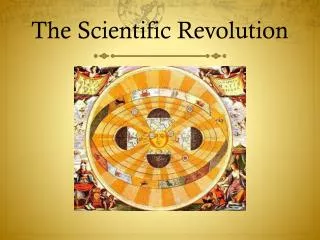
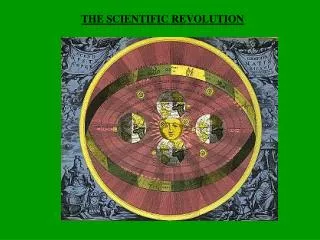
Sun-centered universe
Challenged circular orbits
Universe of staggering size
Earth no different than any other planet
On the Revolutions of the Heavenly Spheres (1543)
5. B. Tycho Brahe (1546-1601) Most sophisticated observatory of his day
Arrogant nobleman
Remained an Aristotelian
Discovered comet shooting right through crystalline spheres
6. C. Johannes Kepler (1571-1630) Student of Brahe
Planetary motion conforms to mathematical formula
Elliptical orbits
Planets do not move at uniform speeds in their orbits
7. D. Galileo Galilei (1564-1642) Early practitioner of the experimental method
Mathematical formula for acceleration of falling objects
Law of inertia
His discoveries using the telescope
Challenges categories of “form” and “matter”
End of his life
8. E. Isaac Newton (1642-1727) Newton far from the perfect rationalist
A great synthesizer
Blends inductive and deductive methods
Argues for a universe governed by natural laws
Principia; Mathematical Principles of Natural Philosophy (1687)
9. F. Francis Bacon (1561-1626) Father of the Scientific Revolution
The Inductive Method
Emphasis on practical, useful knowledge
New attitude toward nature
10. G. Rene Descartes (1596-1650) Significance of Doubt
The Deductive Method
Spatial relationships can be expressed in mathematical formulas
Father of “analytical geometry”
11. III. Causes of the Scientific Revolution Medieval Intellectual Life and Medieval Universities
The Italian Renaissance
Renewed emphasis on mathematics
Renaissance system of patronage
Navigational problems of long sea voyages
Better scientific instruments
12. IV. Consequences of the Scientific Revolution Rise of the “Scientific Community”
--Royal Society of London (1662)
--Academy of Royal Sciences (1666)
The modern scientific method
A universe ordered according to natural laws
13. IV. Consequences of the Scientific Revolution (cont) Laws discovered by human reason
“De-Spiritualized” and de-mystified the Universe
Mechanical View of the Universe
Deistic View of God
--God as the cosmic capitalist
14. The Enlightenment “Siecle de Lumiere”
“The Century of Light”
15. I. What was it? Progressive, Rationalistic, Humanistic worldview
Emerged out of the Scientific Revolution and culminated in the French Revolution
Spokesmen = Rising Middle Class
Paris = Center of Enlightenment
Optimism about mankind’s abilities
16. II. Key Ideas Distrust of Tradition and Revealed Religion
Scientific method could be applied to society as well
Society can get better as risks are taken
Man is naturally good
Good life is on earth
17. III. An Attack on the Old Regime
18. A. The World of the Old Regime Built on tradition
World of hierarchy, privilege and inequality
Allied with the Church
Challenged by the reform impulse of supporters of the Enlightenment
19. B. Conflict with the Capitalistic Middle Class Support for the Middle Class social order against the traditional social order
Size and increasing power of the Middle Class
New notion of wealth
Tension and discord created by the Middle Class
20. C. Popularization of Science The popularity of science in the 17th and 18th centuries
Conversations on the Plurality of the Worlds (1686)—Bernard de Fontenelle
The Scientific Revolution promised the comprehensibility of the workings of the universe
21. D. A New World of Uncertainties The Idea of Progress
The anti-religious implications of the Enlightenment
The relativity of truth and morality
John Locke’s New Psychology
--Essay Concerning Human Understanding (1690)
-- “Tabula Rasa”
22. IV. The Philosophes 18th century French intellectuals
Interest in addressing a broad audience
Committed to reform
Celebrated the scientific revolution
The “Mystique of Newton”
Science applied to society
23. V. The Problem of Censorship The attempt of the Old Regime to control new thinking
Publishers and writers hounded by censors
Over 1000 booksellers and authors imprisoned in the Bastille in the early 1700’s
Battling censorship
24. VI. The Role of the Salon Protection and encouragement offered by French aristocratic women in their private drawing rooms
Feminine influence on the Enlightenment
Madame Geoffrin
25. VII. Diderot’s Encyclopedia Ultimate strength of the philosophes lay in their numbers, dedication and organization
Written between 1751-1772
Attempted to illustrate all human knowledge
Problems with publication
Emphasis on practical science
26. VII. Diderot’s Encyclopedia (cont) Desire to change the “general way of thinking”
Greater knowledge leads to human progress
Emphasized moderation and tolerance
Human nature can be molded
Inalienable rights and the social contract
Knowledge improves goodness
27. VIII. Famous Enlightenment Thinkers