
SlideServe
Menu
Préférences
© SlideServe · v2026

Macromolecules in Biochemistry

parkerg avatar
14 diapositives · 188 Views · Jan 05, 2020

Learn about macromolecules in biochemistry such as insulin, carbon, organic molecules, dehydration synthesis, and polymerization. Discover the importance of monomers and polymers in building large molecules. Explore reactions like hydrolysis and their significance in energy release.
Macromolecules in Biochemistry - slide 1
01 / 14Macromolecules in Biochemistry
1 / 17

Télécharger la présentation

Macromolecules in Biochemistry
Une image / un lien ci-dessous est fourni (tel quel) pour télécharger la présentation

Politique de téléchargement : le contenu du site vous est fourni TEL QUEL pour votre information et votre usage personnel ; il ne peut être vendu, concédé sous licence ni partagé sur d’autres sites sans l’accord de son auteur.Le contenu vous est fourni TEL QUEL, pour votre information et votre usage personnel uniquement. Téléchargez la présentation en cliquant sur ce lien. Lors du téléchargement, si vous ne parvenez pas à télécharger une présentation, l’éditeur a peut-être supprimé le fichier de son serveur.Pendant le téléchargement, si vous ne parvenez pas à obtenir une présentation, le fichier a peut-être été supprimé par l’éditeur.

F I N

Plus de contenu associé

Transcription de la présentation
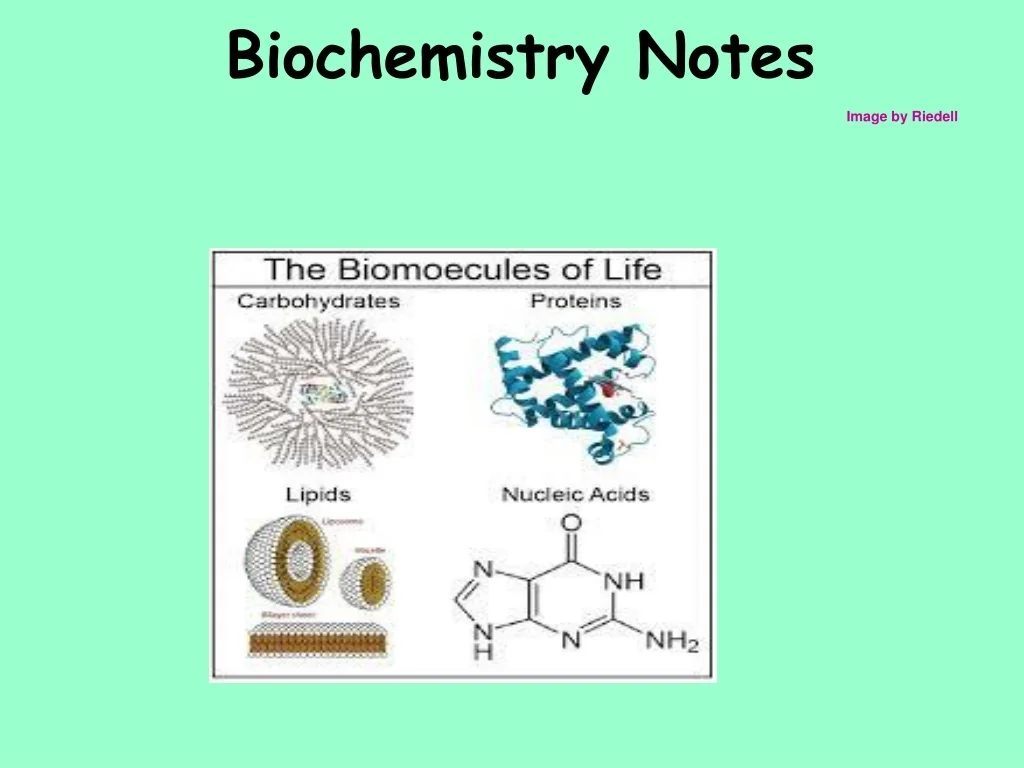
  1. Biochemistry Notes Image by Riedell

  2. VERY, VERY LARGE MOLECULES = ____________________ MACROMOLECULES EXAMPLE: Insulin = C254 H377 N65 O76 S6 Image from: http://www.biology.arizona.edu/biochemistry/tutorials/chemistry/page2.html

  3. _________ is the most important atom found in living things CARBON four It can join to _______ other atoms at same time It can form ______ or _____ so it can make lots of different kinds of molecules. chains rings Images from: http://www.school-for-champions.com/science/chemhydrocarbon.htm

  4. http://www.mrbigler.com/Chem1-C1/topics/vsepr/VSEPR_files/image002.gifhttp://www.mrbigler.com/Chem1-C1/topics/vsepr/VSEPR_files/image002.gif __________ moleculesare found __________ and _____________ atoms ORGANIC in living things contain CARBON http://biologyjunction.com/organic_model_project_bi.htm

  5. One way to join molecules to make a bigger molecule is by ________ a _______ molecule to make a bond. = ____________________ reaction removing WATER dehydration synthesis See an animation http://nhscience.lonestar.edu/biol/dehydrat/dehydrat.html

  6. DEHYDRATION SYNTHESIS“dehydration” “synthesis” =_____________ _____________ water loss put parts together http://io.uwinnipeg.ca/~simmons/macromol/sld003.htm http://www.usd116.org/apalla/biology/unit3/notes/3notes1.htm

  7. POLYMERIZATION _________________ is a ________________ reaction in whichmany _____________ thatare ________ join to make a bigger molecule These small units arecalled ______________ The big molecule theymake is called a _____________ kind of synthesis small subunits similar MONOMERS POLYMER Image by RIedell

  8. EXAMPLE: _________ subunits (A,T,G,C) join together to make a _____ molecule Nucleotide DNA http://www.freewebs.com/genetics37/genetics101.htm

  9. Chemical reactions can also ________ molecules apart. ______________ = kind of chemical reaction in which a molecule is broken apart by addinga________ molecule. “_____” = water “_____” = break apart break HYDROLYSIS WATER hydro lysis See an animation http://trc.ucdavis.edu/biosci10v/bis10v/media/ch02/reaction_types.html

  10. opposite HYDROLYSIS is the _________ of DEHYDRATION SYNTHESIS. Adding a water molecule breaks the bond. http://www.usd116.org/apalla/biology/unit3/notes/3notes1.htm

  11. http://student.ccbcmd.edu/biotutorials/energy/adpan.html ATP is the energy molecule used by all cells. Breaking a bond using hydrolysis is the way ENERGY is released. More on this is Chapters 7, 8,& 9

  12. use BOTH Living things _______ of these kinds of _______ (and MORE) to get the _______they need. reactions materials http://www.animationlibrary.com http://www.cibike.org/CartoonEating.gif

  13. Hydrogen Ions (H+) http://www.guardiantrader.com/images/ph_scale.gif H+ The number of ____ ions determines how _______ a solution will be. acidic More H+ = more acidic

  14. Group Activity • You will receive pieces to make a monomer. • All monomers will be joined together to form a polymer. Macromolecules are formed by joining smaller compounds together. Polymers – monomers joined together Monomers – smaller units