Igneous Rocks
Dive into the fascinating world of igneous rocks, formed from cooling molten material. This comprehensive guide covers both intrusive and extrusive igneous rocks, the difference between magma and lava, and the processes of solidification and crystallization. We'll explore the texture and chemical composition, classifying rocks as felsic or mafic. Discover the significance of cooling rates on crystal size and why vesicles are rare in intrusive rocks. Ideal for geology enthusiasts and students alike, this content includes animations and videos for visual learning.


Igneous Rocks
E N D
Presentation Transcript
Igneous Rocks Rocks Brain-Pop
Igneous Rocks Rocks that form when natural, molten rock-forming material cools and turns into a solid
Liquid(molten)rocks Lava –On the Earth’s surface (Extrusive) Magma– Beneath the Earth’s surface (Intrusive)
Formation Solidification – the change from a liquid to a solid Crystallization – molten magma or lava cools and form solid rocks composed of intergrown mineral crystals Cooling Rates Animation
Intrusive Igneous Rocks: • forms underground • magma never reaches the surface • cools slowly • form large crystals • medium to coarse grained texture • Get exposed at the surface only when rock is uplifted and exposed
Extrusive Igneous Rocks: • Forms on the surface • Lava comes out of a volcano • cools rapidly • forms small crystals • glassy or fine-grained • Covers the surface as lava flows or pyroclastic debris
CRYSTAL SIZE VS. COOLING TIME As cooling time increases, crystal size increases. Crystal SIZE Cooling TIME
Classification of Igneous Rocks: They are classified according to their chemicalcomposition and texture Felsic Rich in: • Silica • Aluminum • Potassium Feldspar • Quartz Mafic • Rich in: • Iron • Pyroxene • Olivine The % of different minerals affect the color of the rock More silica the lighter the rock, less silica the darker More Iron the darker the rock, less Iron the lighter
Classify the following rocks as either:Extrusive or IntrusiveMafic or Felsic Intrusive + Mafic = Gabbro Extrusive + Mafic = Basalt Intrusive + Felsic = Granite Extrusive + Felsic = Rhyolite
Vesicles (Vesicular) • As lava rises and cools to form extrusive igneous rock, • Pressure drops which causes the gases that are in the lava to expand. • These gases form vesicles (cavities) which are the remains of gas bubbles. • Intrusive rocks rarely contain vesicles because they are formed at depth where high pressure stops the gases from expanding.
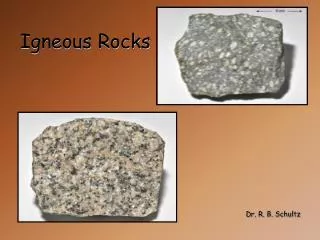
Compare Granite and Basalt • Granite - Intrusive(large crystals) • Felsic (Light In Color) • Basalt - Extrusive (Small Crystals) Mafic (Dark In Color)
Crystal Size Animation Crystallization: • Magma is a mixture of different substances. They all have different melting points. • So as magma cools, some substances will form crystals before other substances. They have a head start in growth and tend to be bigger. • If the magma already has crystals present in it and then is cooled rapidly then you will see large crystals embedded in finer-grained material. • This is called a porphyritic texture
Basaltic lava in Hawaii Top: Basaltic lava flow Bottom: Slow moving lava
Mt. St. Helens Pre eruption Post eruption (May 1980)
Igneous Rock Review 1. What is the difference between magma and lava? 2. What are the two main types of igneous rocks? 3. How can you tell them apart? 4. Why is it not common for Intrusive rocks to have vesicles? Vocabulary: magma, lava, intrusive, extrusive, vesicles, felsic, mafic