SlideServe
Menu
Préférences
© SlideServe · v2026

Passive voice: To be + PII

parsonsa avatar
8 diapositives · 636 Views · Jan 02, 2020

Learn how to construct sentences in passive voice using present simple, continuous, past simple, perfect tenses, and modal verbs. Explore examples and rules for transforming active voice sentences into passive voice.
Passive voice: To be + PII - slide 1
01 / 8Passive voice: To be + PII
1 / 17

Télécharger la présentation

Passive voice: To be + PII
Une image / un lien ci-dessous est fourni (tel quel) pour télécharger la présentation

Politique de téléchargement : le contenu du site vous est fourni TEL QUEL pour votre information et votre usage personnel ; il ne peut être vendu, concédé sous licence ni partagé sur d’autres sites sans l’accord de son auteur.Le contenu vous est fourni TEL QUEL, pour votre information et votre usage personnel uniquement. Téléchargez la présentation en cliquant sur ce lien. Lors du téléchargement, si vous ne parvenez pas à télécharger une présentation, l’éditeur a peut-être supprimé le fichier de son serveur.Pendant le téléchargement, si vous ne parvenez pas à obtenir une présentation, le fichier a peut-être été supprimé par l’éditeur.

F I N

Plus de contenu associé

Transcription de la présentation
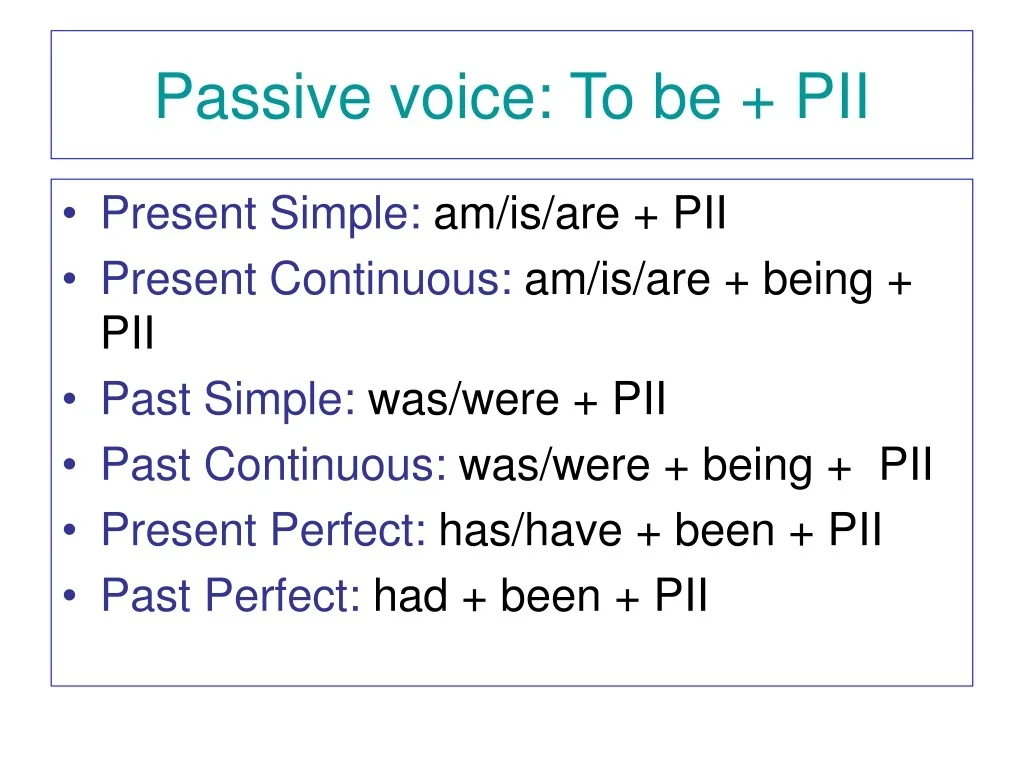
  1. Passive voice: To be + PII Present Simple: am/is/are + PII Present Continuous: am/is/are + being + PII Past Simple: was/were + PII Past Continuous: was/were + being + PII Present Perfect: has/have + been + PII Past Perfect: had + been + PII

  2. The Future & Modal verbs in the passive We use be + a passive participle after will, would, be going to, can, could, must, have to, should, etc … e.g: The Queen will open the new hospital. →The new hospital will be opened by the Queen. They should throw away this rubbish. →This rubbish should be thrown away. My brother can play the piano. →The piano can be played by my brother.

  3. Use: The Passive To emphasize the object of the active sentence, we use the passive (the object of an active sentence becomes the subject of a passive sentence). Use “By” in the passive sentence when we want to say who/what did the action. Active: Bill invented the telephone. object Passive: The telephone was invented by Bill. subject Active: John drinks beer before meals. Passive: Beer is drunk before meals by John.

  4. Notes: The Passive • The rules for the tense usage in the passive are the same as in the active. • In the passive, when we don’t want to mention or we don’t know the agent (the doer of an action) or the agent is not important, “By” is not used. (Subjects in the active sentences: people, you, he, one, they, someone, …. “By” is not used.) Active: They clean streets every day. Passive: Streets are cleaned every day. Active: The thief stole much money. Passive: Much money was stolen.

  5. Notes (cont) 3. Some verbs, for example, give, send, show, pay, teach, offer, hand, …. have 2 objects: a person and a thing. She gave me a book for my birthday. In the passive, we often make the person the subject, not the thing. → a. I was given a book for my birthday. → b. A book was given to me for my birthday.

  6. Have/get something done If you 'have/get something done', you get somebody else to do something for you. Ex: We must have/get another key made

  7. Turn the following into the passive voice. Do not mention the agent unless it seems necessary. 1 The architect has drawn plans for an extension to the house. ……………………………………………………………………………. 2 They didn't pay me for the work; they expected me to do it for nothing. ……………………………………………………………………………….. 3. Somebody repaired her car yesterday. She …………………………………………………………………………………. 4. The mechanic serviced my car last week. I……………………………………………………………………………………… 5. A Japanese firm makes these television sets. ……………………………………………………………………………………………. 6. They haven’t cleaned the streets this week. …………………………………………………………………………………………… 7. No one has signed this cheque. …… ………………………………………………… Plans have been drawn for an extension to ….. I wasn’t paid for the work; I was expected to do it for nothing. had/got her car repaired yesterday had/got my car serviced last week. These television sets are made by a Japanese firm The streets haven’t been cleaned this week. This cheque hasn’t been signed.

  8. Turn the following into the passive voice. Do not mention the agent unless it seems necessary. 8. He couldn’t repair the broken vase. … ……………………………………………… 9. The garden still needs digging. The garden hasn’t .……………………………………………. 10. The robbers made the bank manager hand over the money ………………………………………………………………………………………… 11. They’ll have to change the date of the meeting again. …………………………………………………………………………………………… 12. The garage is going to repair the car for us next week. We are going ………………………………………………………………………… 13. They will catch all the prisoners again by tonight. ……………………………………………………………………………………….. 14. They are watching my house. ………………………………………………………………………………………….. The broken vase couldn’t be repaired. been dug. The bank manager was made to hand over the money by … The date of the meeting will have to be changed … to have/get the car repaired next week. All the prisoners will be caught again by tonight. My house is being watched.