Universal Biofunctionalization of Surface-Bound GEPIs via ‘Click’ Chemistry
Explore a universal strategy for modifying genetically engineered protein inhibitors with bioactive molecules using ‘click’ chemistry. This approach enables diverse biofunctionality on solid surfaces, benefiting bionanotechnology and biomedical applications.

Universal Biofunctionalization of Surface-Bound GEPIs via ‘Click’ Chemistry
E N D
Presentation Transcript
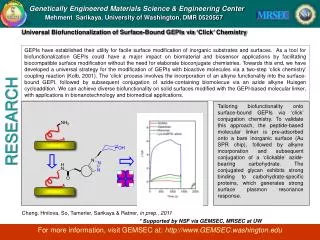
Genetically Engineered Materials Science & Engineering Center Mehment Sarikaya, University of Washington, DMR 0520567 Universal Biofunctionalization of Surface-Bound GEPIs via ‘Click’ Chemistry GEPIs have established their utility for facile surface modification of inorganic substrates and surfaces. As a tool for biofunctionalization GEPIs could have a major impact on biomaterial and biosensor applications by facilitating biocompatible surface modification without the need for elaborate bioconjugate chemistries. Towards this end, we have developed a universal strategy for the modification of GEPIs with bioactive molecules via a two-step ‘click chemistry’ coupling reaction (Kolb, 2001). The ‘click’ process involves the incorporation of an alkyne functionality into the surface-bound GEPI, followed by subsequent conjugation of azide-containing biomolecue via an azide alkyne Huisgen cycloaddition. We can achieve diverse biofunctionality on solid surfaces modified with the GEPI-based molecular linker, with applications in bionanotechnology and biomedical applications. Tailoring biofunctionality onto surface-bound GEPIs via ‘click’ conjugation chemistry. To validate this approach, the peptide-based molecular linker is pre-adsorbed onto a bare inorganic surface (Au SPR chip), followed by alkyne incorporation and subsequent conjugation of a ‘clickable’ azide-bearing carbohydrate. The conjugated glycan exhibits strong binding to carbohydrate-specific proteins, which generates strong surface plasmon resonance response. RESEARCH Cheng, Hnilova, So, Tamerler, Sarikaya & Ratner, in prep., 2011 * Supported by NSF via GEMSEC, MRSEC at UW For more information, visit GEMSEC at: http://www.GEMSEC.washington.edu