Download
1 / 14
140 likes | 269 Vues
The DNA Barcoding meeting held on April 7-8, 2006, at Kirstenbosch National Botanical Garden gathered 67 participants from Southern Africa and beyond. Hosted by SANBI, CBOL, and BioNET-SAFRINET, the meeting focused on clarifying barcoding concepts, applications, and funding opportunities. Key projects identified include pest species for quarantine, endangered vertebrates, and invasive species, emphasizing the need for sustainable initiatives with local support. Future steps include forming steering committees, establishing a Regional Barcode Network, and enhancing local training in taxonomy and barcoding.

E N D
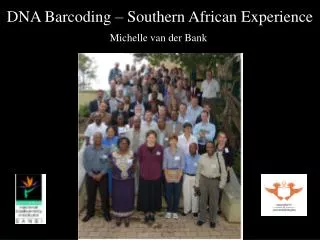
DNA Barcoding – Southern African Experience Michelle van der Bank
7 & 8 April 2006 – DNA barcoding meeting hosted by SANBI SA, CBOL, BioNET-SAFRINET & BioNET • First of the regional meetings held by CBOL • Held at Kirstenbosch National Botanical Garden attended by 67 participants from 11 southern African countries, 4 other African countries, 2 from Asia, & 10 CBOL officials
Goals of the southern African meeting • Clarify concepts and applications of barcoding • Raise awareness of the uses of DNA barcoding for biodiversity research and species identification • Raise awareness of the pitfalls of barcoding • Explore the potential applications of DNA barcoding • Clarify funding opportunities
Meeting results Several barcoding projects have been identified having the following characteristics: • Address an immediate need • Focus on species of commercial value, endangered species, and endemic species • Have potential users and supporters • Are ready to be implemented by identified leaders in the region • Have an adequate supply of reference collections and taxonomic experts in the region • Are sustainable ( have users, fundings)
Projects identified • Pest species related to plant quarantine • Macro-invertebrates used for water quality assessments • FISH-BOL • Endangered vertebrates • Wildlife species and their related parasites and pathogens • Pests on livestock species, e.g., ticks, biting flies, parasites • Invasive alien species • Rare / endangered species (i.e. Cape Floristic Kingdom) • Plants and animals used medicinally • Groups of interest to specific sectors such as public health (mosquitoes), commercial fishermen (abalone), pet trade (birds)
Regional needs for capacity building and training • Biodiversity act (NEMBA No 10 of 2004) • Capacity is uneven distributed among countries • Sequencing facilities exist, establishing them in every countries would not be cost-effective • Way to go: many local labs capable of extracting DNA, PCR, and sending PCR products to central sequencing facilities in the region • Training in taxonomy, curation, barcoding is an important need
Next steps CBOL and BioNET to implement the following in southern Africa •Create Steering Committees for selected projects • Facilitate the formation of a Regional Barcode Network • Identify Leading Labs for information/staff exchange • Identify Participating Labs involved in regional or global projects for local training • Material Transfer Agreements • Create short courses • Respond to requests for assistance in writing proposals to funding agencies for barcoding projects •Provide copies of successful barcoding proposals on request
Our own experience: Barcoding the flora of the Kruger National Park
The four steps of barcoding • Collection • Extraction of DNA • PCR / Sequencing / Producing barcode • Databasing
Collection • Permit • Use of herbarium samples for DNA extraction • Housing of herbarium vouchers
Extraction of DNA • DNA bank at UJ (Darwin Initiative - MOU)
PCR / Sequencing / Barcode • Fully equipped lab at University of J’Burg • Primers from the Plant Working Group (matK, rbcL, rpoC1, rpoB, accD, YCF5, ndhJ, trnL-F, trnH psbA, trnS-G, trnK-rps16, rpl36-infA-rps8, atpB-rbcL, ycf6-psbM, trnV-atpE)
Databasing • BOLD website (Robert Hammer) available for plants ?
Acknowledgements • CBOL • Plant Working Group (Robyn Cowan) • Elida Oyieke & Dickens Odeny