Understanding Independent and Dependent Events in Probability
This guide explores the fundamental concepts of independent and dependent events in probability. It explains key terms and principles, including the fundamental counting principle, the multiplication rule for probabilities, and the distinction between unbiased and biased samples. It highlights how to calculate the probabilities of single and compound events, offering practical examples such as spinners and number cubes. The information is based on textbook references and provides clear formulas for calculating event probabilities, making it an invaluable resource for learners.

Understanding Independent and Dependent Events in Probability
E N D
Presentation Transcript
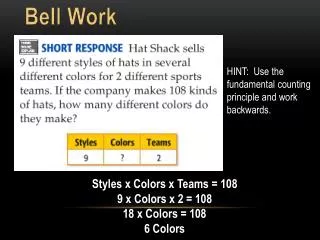
Bell Work HINT: Use the fundamental counting principle and work backwards. Styles x Colors x Teams = 108 9 x Colors x 2 = 108 18 x Colors = 108 6 Colors
Independent and Dependent Events Textbook page 391
Independent Events • Compound Events: Consists of two or more simple events. • Independent Events: The outcome of one event does not affect the other event.
Independent Events Write this formula
Independent Events Find the probability of each event. Find the probability of both events occurring by multiplying the probability of event.
Independent Events Find the probability of each event. The spinner has five colors: red, yellow, blue, green, purple. Probability of landing on blue? The number cube has six sides. Probability of rolling a 3 or 4? 2. Find the probability of both events occurring by multiplying the probability of event. 1 5 2 or 1 6 3 1 x 1 = 1_ 5 3 15
Independent Events 2 or 1 6 3 First roll, 2 or 4. What’s the probability? Second roll, 5. What’s the probability? What’s the probability of rolling what you need? 1 6 1 x 1 = 1_ 3 6 18
Dependent Events • Dependent Events: The outcome of one event affects the outcome of another event.
Dependent Events Write this formula
Dependent Events 4 oranges, 7 bananas, 5 apples 16 pieces of fruit 7 x 6 = 42 = 7 16 15 240 60 4 x 5 = 1 x 1 = 1 16 15 4 3 12 5 x 7 = 35 = 7 16 15 240 48 4 x 3 = 1 x 1 = 1 16 15 4 5 20
Unbiased and Biased Samples Textbook page 414
Unbiased Sample • Unbiased Sample: Accurately represent the population.
Biased Sample • Biased Sample: One or more parts of the population are favored over others.
Unbiased and Biased Samples Determine whether each conclusion is valid.
Unbiased and Biased Samples Determine whether each conclusion is valid.
Exit Slip Determine whether each conclusion is valid. Justify your answer.