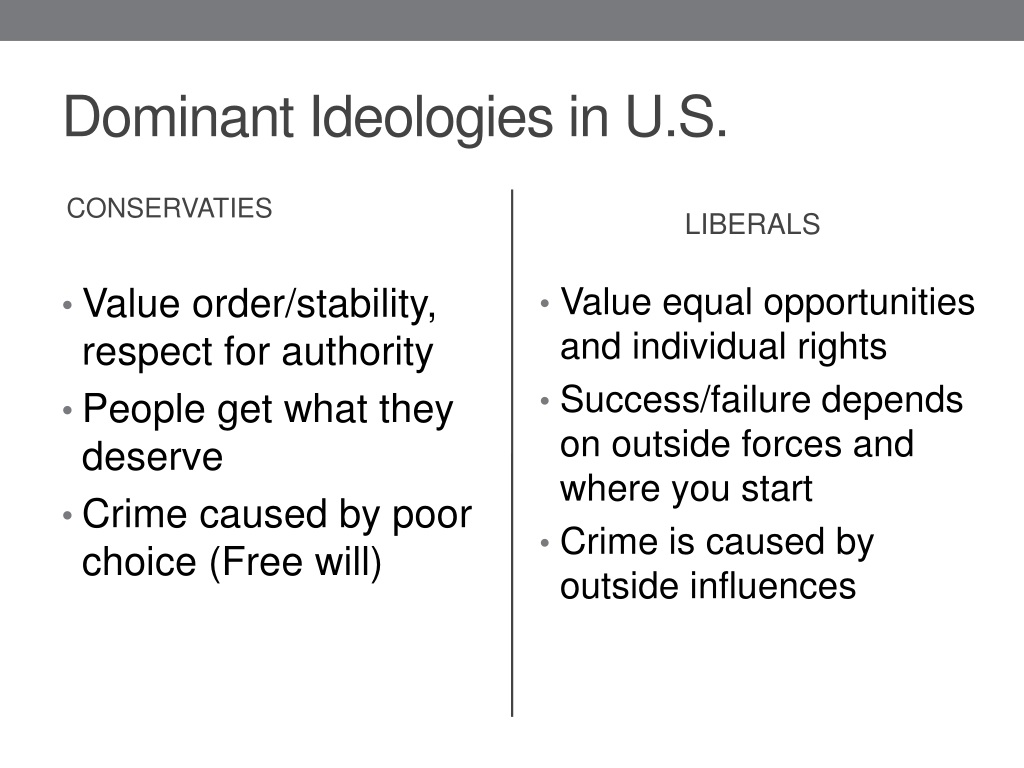
Dominant Ideologies in U.S. CONSERVATIES LIBERALS Value equal opportunities and individual rights Success/failure depends on outside forces and where you start Crime is caused by outside influences • Value order/stability, respect for authority • People get what they deserve • Crime caused by poor choice (Free will)
Implications of Ideology for Crime and Justice • Conservatives tend to fit with “Classical School” • “Neo-Classical” = deterrence, incapacitation • James Q. Wilson’s “policy analysis” • Liberal/Progressive fit with positive school • Favor decriminalizing some acts • “Root causes” of crime only fixed by social change • Rehabilitation may be possible • Elliott Currie = ample evidence that government can address social ills and prevent crime • Radical = Marxist/conflict theory
Ideology as “hidden agenda” • Many policies and programs are driven more by ideology than empirical evidence • Intensive supervision probation (conservatives) • Restorative justice (liberals)
The “Martinson Report” (MR) • The “Martinson Report” was review of studies on rehabilitation published in the early 1970s • Concluded that not much is working • Used by politicians as the reason for abandoning rehab • Social Context of the 1960s • Hippies, Watergate, Attica, Viet Nam, Kent State… • Conservatives? SKY IS FALLING • Liberals? Cannot trust the government • Reality = liberals and conservatives were both “ready” to pull the plug on rehabilitation
The Limits of Empirical Evidence • Criminologists tend to be cautions with conclusions • All studies are flawed in some way • Politicians and public tend to “over generalize” from a single study • This can lead to bad policy • RAND Felony Probation study • Domestic Violence Experiments
Good theory makes good policy… • In a perfect world, programs and policies would flow from empirically supported theories of crime • Unfortunately, people often “shoot from hip” • Policy without Theory • The “panacea” problem: scared straight, intensive probation, boot camps, warm and fuzzy circle… • Some hope in “evidence-based” movement • Multisystemic Therapy (MST) • Targets for change = parental supervision, delinquent friends, reducing rewards for deviance…
Good theory makes good policy… • In a perfect world, programs and policies would flow from empirically supported theories of crime • Unfortunately, people often “shoot from hip” • Policy without Theory • The “panacea” problem: scared straight, intensive probation, boot camps, warm and fuzzy circle… • Some hope in “evidence-based” movement • Multisystemic Therapy (MST) • Targets for change = parental supervision, delinquent friends, reducing rewards for deviance…
Crime and the Media What do Americans believe about Crime and the Justice System? Where and how do they develop these beliefs? What are the consequences of these beliefs?
Criminology vs. Other Science • How many “crime related” T.V. shows can you name off the top of your head? • Crime and the CJS on T.V. news or newspapers? • Crime and the CJS in movies and fiction books? • How does this compare to biology, psychology, or physics?
Who Cares? • People get information about most things from television, newspapers • BUT—with regard to crime, the question becomes, “How accurately does the media reflect crime, criminals, and the criminal justice system?” • “Back stage” behavior
Sources of Media Bias—or “Reasons for Skepticism” • Newspapers and T.V. news • Crime in general captures audiences • Violent crime, especially stranger violence • “If it bleeds it leads” • Politicians • “Get tough” on crime = political payoff • Entertainment • Need for “excitement” belies accurate portrayal of criminals and criminal justice system • Think “COPS”
Types of Distortion • Creation of “crime waves” • Attention to violent crime • What about “white collar crime?” • Creating/Spreading Crime Myths • Halloween psychopaths • The Serial Killer Epidemic • Satanic Daycare
2011-12 Class Survey: Crime Trends • How many murders occur in the U.S. in any given year? • Mean (average) = 44,472 • Actual = 13,500 • Is “profiling” an effective way to catch serial killers? 73% yes • Can you remember the DC “sniper” case? • Behavioral Science Unit of FBI?
2012 Class Survey: Percent agree for crime trends
Class Survey: Percent agree for crime trends
What percent of homicide caused by serial killers?
What percent of homicide caused by serial killers?
What percent of those found guilty had a trial (not plea)?
What percent of those found guilty had a trial (not plea)?
Children poisoned with Halloween candy in past 20 years?
Children poisoned with Halloween candy in past 20 years?
Children abducted by stranger in typical year in U.S.
Children abducted by stranger in typical year in U.S.
Media and Crime: Summary • Tendency to distort reality: • Political rhetoric • If it bleeds it leads (other types of crime?) • Overemphasis on crime (crime waves) • An “effective” criminal justice system • Profiling, CSI, Police Detectives… • Why is any of this important • Dorthy and W.I. Thomas (1928), if people believe it, it is “real in its consequences.”
Fear of Crime • Why is “fear of crime” important? • How fearful are Americans? • Are some Americans more fearful than others? • Structural Factors (size of town/city, crime rates) • Individual Factors (age, race, gender)
2011 Class Survey, % Afraid of Victimization by Gender
Attitudes Towards Punishment • When polling questions are broad/general, it appears that Americans are punitive and punishment oriented: • Do you support the death penalty for convicted murderers? (75% yes) • In general, do you think the courts in this country deal too harshly or not harshly enough with criminals? (80% not harsh enough). • Consistency across race, class, other factors • BUT: Adding complexity to the questions affects answers
More Complex Questions • 2011 Class Survey Responses • Do you support the Death Penalty? • 64% • If given the option of “life without parole?“ • 54% • Applegate, Cullen, Turner and Sundt (1996) • 3 Strikes legislation • 90% of Ohio residents supported 3 Strikes in general • Only 17% choose life in prison as a punishment when given specific cases
What about “Rehabilitation” or Prevention? • Again, public attitudes are complex • Does the public want their pound of flesh? • YES, believe in retribution and deterrence • Does the public also want rehabilitation? • YES, especially for drug/property offenses • Is the public willing to use tax dollars for prevention? • YES
Feature Presentation (If Time) Things to Watch for: • Ideology (not my primary reason for showing) • BUT, very ideological movie • Role of media • Fear of crime • Race